
Benchmarks Examples (Part 1)

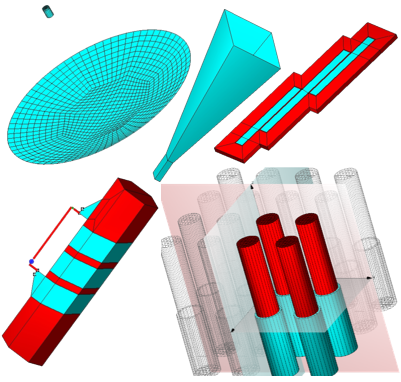
In this application note, several benchmark models are created and simulated to clearly demonstrate WIPL-D Pro capabilities and practical functionality in real scenarios. WIPL-D Pro is a full-wave 3D EM solver based on the Method-of-Moments (MoM) and enhanced with quadrilateral mesh and higher-order basis functions (HOBFs). All models are demonstrational, with a focus on output results and relatively short simulation times for the reader. Examples include a reflector antenna with parabolic dish, microstrip patch antenna, printed microstrip band-pass filter, horn antenna, coil with ferrite core, dielectric rod antenna, and dielectric rod antenna arrays. All simulations were carried out on a regular desktop PC almost instantaneously.
View PDF

Benchmark Examples (Part 2)

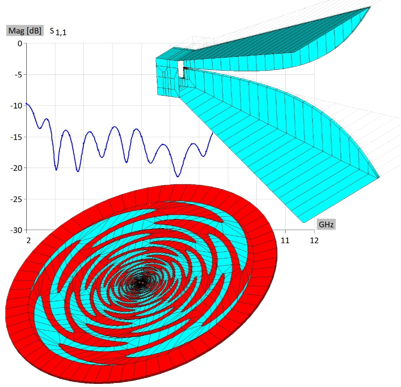
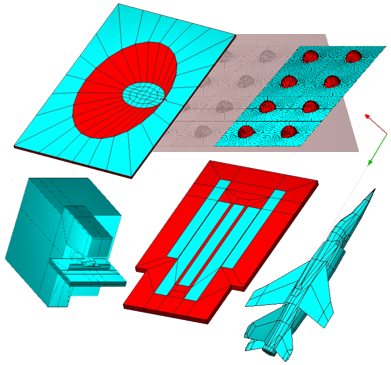
This application note represents an addition to the document Benchmark Examples (Part 1); however, it can be read independently without prior review of the previous material. Various benchmark examples are created and simulated to clearly demonstrate WIPL-D Pro capabilities effectively, with a focus on output results and relatively short simulation times for the reader. Examples include a 12 m long fighter aircraft at 0.3 GHz, printed band-pass filter, monopole antenna on a 30 m square plate at 300 MHz, ultra-wideband elliptical antenna, hemispherical dielectric antenna, hemispherical dielectric antenna arrays, welder machine, and aperture-coupled waveguides. All simulations were carried out on a regular desktop PC in very short simulation time.

View PDF

Benchmark Examples (Verifying Accuracy)

This note presents benchmarks requested by the Technical Committee on Electronics Simulation Technology (EST) of the Institute of Electronics, Information and Communication Engineers (IECE) in Japan. WIPL-D simulation results are compared with known solutions to establish the accuracy of the simulations, either with analytical results, measured data, or results from EM software modules also provided by EST specifically for each problem. Examples include RCS from metallic and dielectric spheres, input impedance and gain of dipole, microstrip line-fed patch antenna, waveguide slot antenna return loss, standard gain horn, microstrip stub, and microstrip capacitor. All models are simulated on regular desktop PC with minimum requirements.

View PDF

Efficient Usage of CPU and GPU Hardware Resources

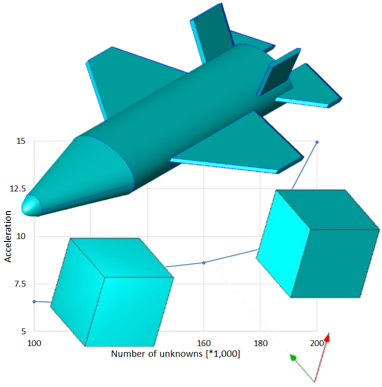
This application note demonstrates the efficient usage of hardware resources (CPU and GPU) in WIPL-D EM simulations, which consist of two main phases: matrix fill-in followed by matrix inversion. For electrically small problems with a few thousand unknowns, fill-in dominates, while for large problems above 50,000 unknowns, inversion can take
80–90% of total simulation time. Multi-core CPUs efficiently accelerate fill-in, and the WIPL-D GPU Solver leverages NVIDIA CUDA™ GPUs to significantly speed up inversion, achieving up to tenfold acceleration. Using multi-core fill-in and multi-GPU inversion, a 200,000-unknown problem can be simulated in under one hour, clearly illustrating how modern hardware dramatically reduces EM simulation times.

View PDF

GPU Accelerated MoM Matrix Inversion

The WIPL-D GPU Solver significantly reduces simulation time, especially for the dominant MoM matrix inversion, which is crucial for complex electrically large structures with high numbers of unknowns. Using GPUs instead of CPUs dramatically accelerates problems with 50,000–150,000 unknowns, otherwise feasible on multi-core CPU workstations with sufficient RAM. This note demonstrates simulation times on an affordable workstation with four low-cost GPU cards and several fast drives. Symmetrical system matrices, as in purely metallic structures, allow reduced inversion for further time savings. Example problems include a Luneburg lens and a 440‑lambda Cassegrain reflector antenna, solved in just six hours for 500,000 MoM unknowns.

View PDF

Exploiting Multithreading of Modern CPU

This application note focuses on cases where MoM advantages are minimal: ultra-wideband simulations, many frequency points, and electrically small or moderate-size structures (few unknowns, high mesh density, and limited HOBF usage for these specific examples). Simulation times are compared on a modern quad-core CPU versus a dual 12-core setup, with efficient parallelization of matrix fill-in. For electrically large problems, matrix inversion dominates, and adding even a single inexpensive GPU dramatically accelerates it. Modern multi-thread CPUs with GPU support significantly reduce times for UWB applications or detailed small antennas, expanding the range of EM problems solvable with acceptable simulation times for EM and RF engineers.

View PDF

IoT Scenario Within an Aircraft Apartment

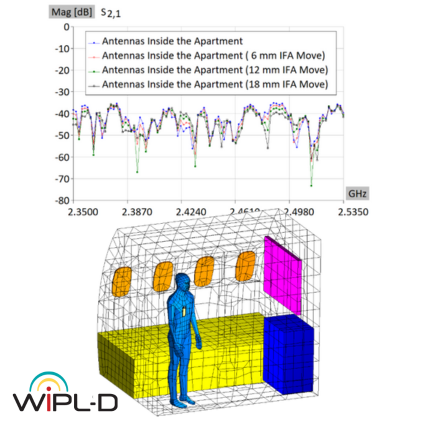
The operating environment of an Internet of Things (IoT) system is usually complex, including obstacles such as furniture or partitions in indoor scenarios. A typical example is a luxury aircraft apartment containing a passenger and several pieces of furniture. One side of the IoT link is a cellphone equipped with a printed dipole antenna inside its housing, while the other side is a warning sensor installed in a locker compartment, simplified as an inverted-F antenna (IFA). The system operates at approximately 2.40 GHz. All simulations are carried out using WIPL-D Software, a cutting-edge full-wave 3D electromagnetic Method-of-Moments tool, providing highly accurate results with efficient computation and reasonable simulation time.

View PDF

RFID Applications

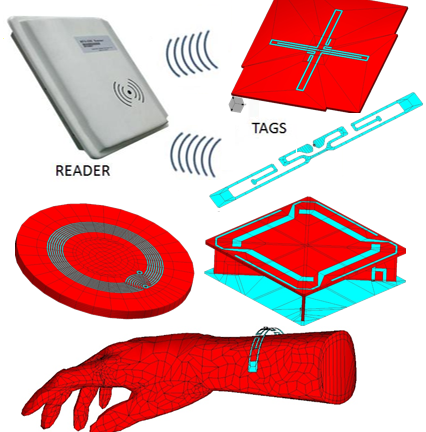
Radio-frequency identification (RFID) is a key electromagnetic (EM) application where WIPL-D software suite excels significantly. RFID uses wireless EM fields to transfer data, mainly for automatic identification and tracking of tags on target objects. WIPL-D Pro, based on the Method of Moments, efficiently simulates small and simple tags in seconds and handles open radiating problems, including coupling between distant objects, without requiring a boundary box or meshing the space between reader and tag. Applications demonstrated include industrial RFID tags (even wound around a human wrist), a 13.56 MHz RFID reader, multiband cross-spiral tags, and quadrifilar spiral antennas with circular polarization for UHF mobile RFID readers.

View PDF

RFID Applications Part 2

The application note “RFID Applications” presents various RFID designs, including typical reader/tag setups, flexible substrates, and miniaturization approaches. Simple RFID readers are simulated instantly with very few unknowns on a standard desktop PC, while more complex scenarios involving coupling between two antennas are solved in just a few efficient minutes. Tags are even simpler, including advanced cases like meandered tags wrapped around a wrist or optimized with Er = 40 to minimize dimensions. The most complex example involves multiple tags on plastic containers with a reader 2 m away; coupling and time-domain responses are efficiently obtained since the space between antennas is not meshed, keeping solution complexity very low.

View PDF

Apertures in PEC Applied to FSS Simulations

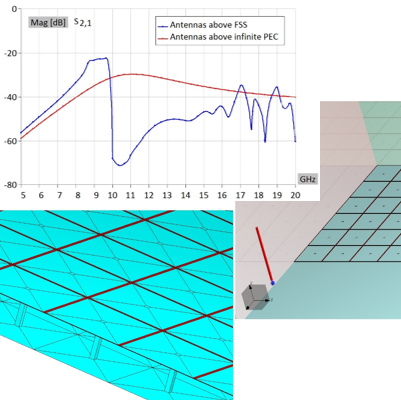
This application note demonstrates simulation of a classical FSS structure using the “apertures in PEC/PMC plane” feature. The FSS consists of a large periodic array of mushroom-type printed patches separated by narrow gaps. Two antennas excite a 32×32 array with TE or TM polarization. Applying two symmetry planes reduces the problem to a 16×16 array, cutting the number of unknowns to roughly one quarter. This scenario can be simulated on a standard desktop or laptop in just minutes per frequency point. Around 33,000 unknowns are required, but a single inexpensive CUDA-enabled GPU significantly speeds up the simulation. Results confirm measurements, showing the 10–13 GHz frequency gap and local resonances in a narrower 0.5 GHz band.

View PDF

Influence of a Fence Located Between Communicating Drones

Two real-life scenarios with three drones communicating at 2.4 GHz were analyzed, focusing on electromagnetic aspects of the physical layer and overall performance. In both scenarios, drones are positioned above a ground plane modeled as an infinite PEC surface, with a metallic wire fence introduced between two drones. The difference lies in the method used to model the fence. Simulation results show the fence slightly affects
S-parameters, with variations within ±5 dB, while its position and modeling method have minimal impact. Using Wire entities reduces unknowns and computational resources without losing accuracy. All simulations were efficiently performed using WIPL-D, a full-wave 3D MoM software, demonstrating suitability for drone scenario analysis.

View PDF

MoM Simulation for Human Position Detection in IoT

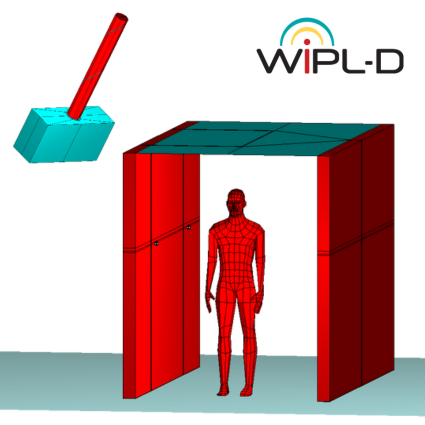
The 2.4 GHz IoT scenario in this application note models a corridor with the ceiling and floor as metallic plates and an infinite PEC plane, a human phantom, and three Wi-Fi routers, one transmitting and the others receiving signals simultaneously. Received signals can detect human movement and determine precise position, as receiver currents vary with location. Simulation results can serve as reference for IoT measurements, enabling accurate position determination using a precomputed database. All simulations were performed using WIPL-D Software, a full-wave 3D EM Method-of-Moments solver with Surface Integral Equations. Despite usually requiring asymptotic methods, full-wave MoM was feasible, with about 37 minutes per phantom position.

View PDF