
Cavity Filter Design and Optimization

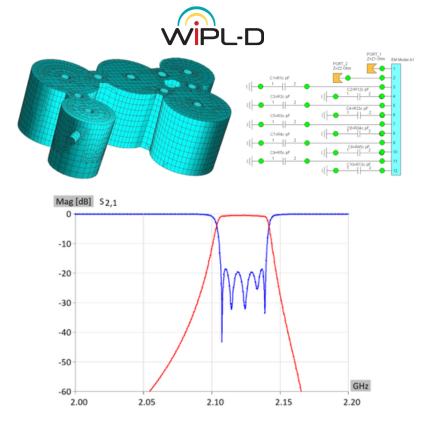
This application note demonstrates extremely efficient interoperability of WIPL-D software: WIPL-D Pro CAD, WIPL-D Microwave Pro, WIPL-D Pro, and WIPL-D Optimizer—for design, modeling, simulation, and optimization of cavity filters. A complex 2.1 GHz five-cavity pass-band filter is imported, meshed, and simulated in WIPL-D Pro CAD and WIPL-D Pro, then optimized in WIPL-D Microwave Pro with WIPL-D Optimizer. EM simulation is done once, while optimization uses a combined 3D/circuit model, where tuning capacitors emulate screw adjustments, enabling fast, precise tuning. WIPL-D supports simplified geometries in WIPL-D Pro or detailed CAD-imported models in WIPL-D Pro CAD, offering flexibility, accuracy, and speed for advanced filter design.
View PDF

Designing a Band Pass Filter with WIPL-D Filter Designer

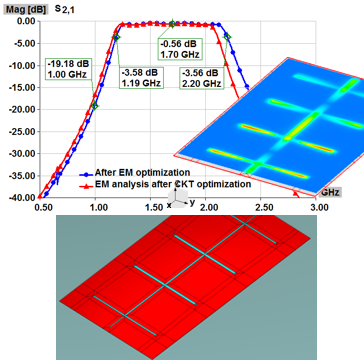
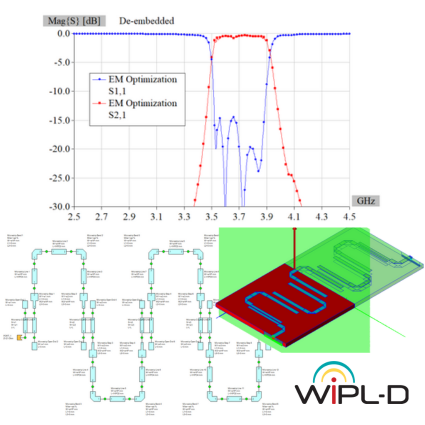
This application note describes design of a microstrip filter, emphasizing an efficient optimization technique based on a simplified Space Mapping method. The process results in a filter ready for prototype fabrication with minimal manual and numerical effort. Design success is maximized by considering standard fabrication limitations, including substrate selection and dimensional constraints. All simulations are carried out with high numerical efficiency on a standard desktop computer, requiring no specialized hardware. This demonstrates that WIPL-D provides a complete, practical, and reliable environment for fast, accurate microstrip filter design, making it suitable for academic research and commercial microwave circuit applications.

View PDF

Matching Network Design for Power Amplifiers

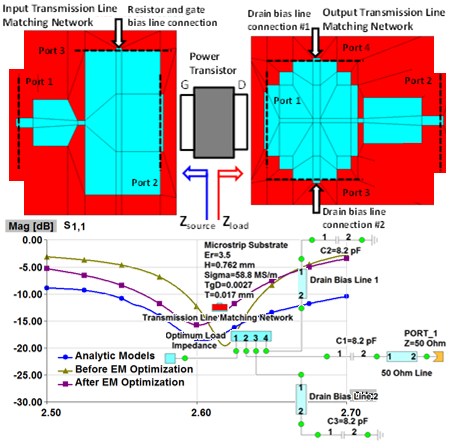
This application highlights the design and simulation of power amplifier matching networks using WIPL-D Microwave Pro, providing a complete environment for accurate, efficient, and fully integrated modeling and analysis. A commercially available power transistor is used to illustrate typical matching network topologies and the full design flow, emphasizing the importance of including electromagnetic analysis to capture coupled discontinuity effects that can significantly impact performance. Designs are demonstrated on a microstrip substrate recommended by the manufacturer, with easy adaptation to alternative substrates, showcasing WIPL-D Microwave’s versatility, precision, and efficiency for advanced microwave amplifier engineering.

View PDF

Microstrip Combline Bandpass Filter

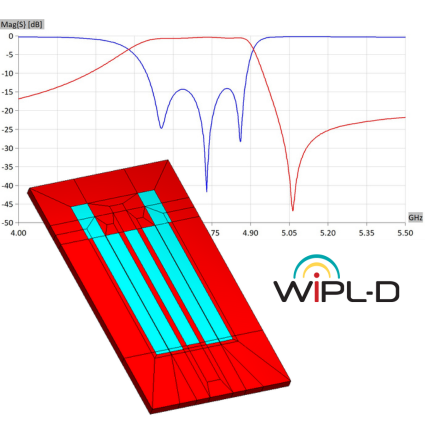
Simulation of a microstrip combline bandpass filter is performed using WIPL-D Pro, full-wave 3D MoM solver. The filter operates from 4 to 5.5 GHz and is modeled on a cost-effective desktop using a common microstrip substrate. With only 37 simulated frequency points, the WIPL-D Fitter accurately reconstructs the wideband response, revealing clean
S-parameters and a useful transmission zero above the passband for improved selectivity. Optimized resonator lengths, line widths, and gaps are easily realizable in standard technology, enabling easy prototype fabrication. The workflow highlights WIPL-D’s efficiency and reliability for both commercial and academic filter design while offering practical guidance for further development and research.

View PDF

Design Flow for Microstrip Bandpass Filter

The accurate and efficient design of a microstrip bandpass filter can be achieved using the WIPL-D design suite, which integrates microwave circuit, EM, radiation, and near-field analysis within a single environment. The built-in Filter Designer enables direct synthesis of a microstrip filter based on user specifications through wizard-like interface. Analytic microstrip elements can be optimized to meet specifications and then seamlessly transferred to the EM model. A metallic enclosure can be added to study shielding effects, which may impact fundamental and parasitic bandwidths. Techniques for suppressing box modes can be tested immediately using full-wave EM simulation, avoiding costly and time-consuming rework after filter fabrication.

View PDF

Power Detector with Zero-Bias Schottky Diode

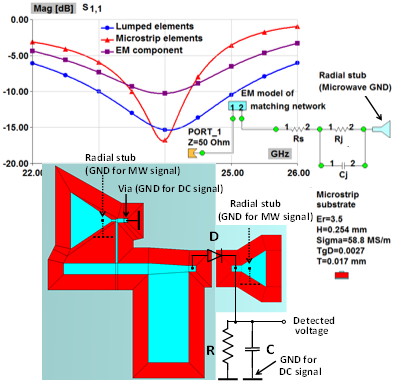
This application note presents the design of power detectors using WIPL-D Microwave, a complete one-stop environment for microwave circuit designers. Analytical-element-based modeling can be seamlessly expanded to full 3D EM analysis, automatically transferring any schematic with proper layout into an EM component when higher accuracy is needed. Detector choices, including non-matched or matched configurations, depend on the specific application. For matched detectors, simple networks optimize sensitivity, while more complex networks may need to improve return loss. Electromagnetic modeling ensures all effects are accurately captured, highlighting WIPL-D Microwave’s efficiency, precision, and versatility for advanced power detector design.

View PDF

Differential Filter Design and Optimization

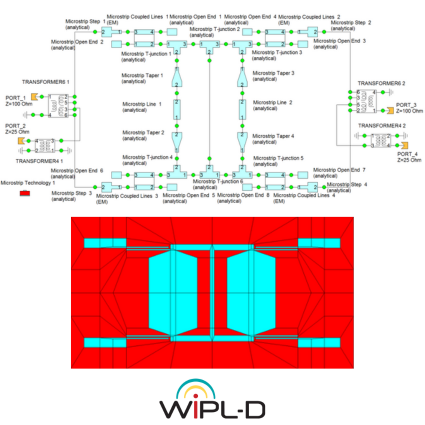
In this application note, analysis and optimization of a differential microwave circuit using WIPL-D Microwave Pro is presented. Differential/common-mode analysis is performed by connecting transformer elements to convert single-mode S-parameters to differential/common-mode S-parameters. Differential filter illustrates the procedure, analyzed as an ideal transmission line, a microstrip schematic, and a 3D EM component. Converting the ideal circuit to a realistic microstrip introduces parasitic effects, fully considered during EM optimization. This method applies to other differential components such as amplifiers, couplers, and antenna matching networks, enabling accurate simulation and efficient optimization of complex microwave circuits.

View PDF

Rectangular Waveguide
Iris-Coupled Filter

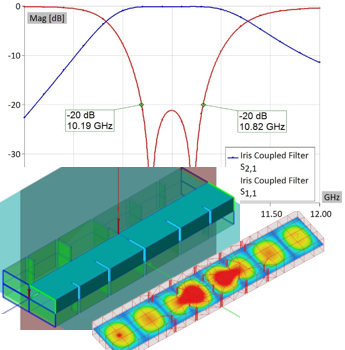
This application note describes the detailed simulation of a band-pass interdigital filter in rectangular waveguide technology, modeled in WIPL-D Pro CAD using the native editor and built-in primitives. A symmetry plane was carefully utilized to reduce structural complexity, and two waveguide ports served as feeders. The model was simulated from 5 GHz to 14 GHz at 26 frequency points, with convergence checks performed to ensure high accuracy. After the convergence study, filter dimensions were finely tuned to achieve S11 values below –20 dB in the passband (8.30–10.86 GHz). Simulations can be efficiently performed on any desktop or laptop, preferably with multiple CPU cores, with per-frequency simulation times measured in seconds overall efficiency.

View PDF

Effective Antenna Design by
EM-Circuit Co-Simulation

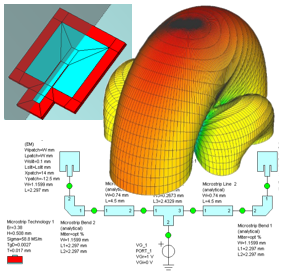
Circuit–EM co-simulation reduces complexity by dividing a system into parts requiring full-wave electromagnetic analysis and parts handled with predefined circuit models, enabling efficient evaluation of large structures. In this case, two microstrip patch antennas are combined with a detailed feeding network consisting of microstrip lines, a T-junction, and several bends, forming a compact system analyzed from 9 to 11 GHz in nine evenly spaced points around a 10 GHz center. Through tight coupling between WIPL-D’s EM and circuit solvers, the overall problem is decomposed into smaller electromagnetic tasks, significantly cutting the number of unknowns and ensuring that simulation runtimes remain short on standard desktop computer.

View PDF

Bond Wires as Interconnect Technology

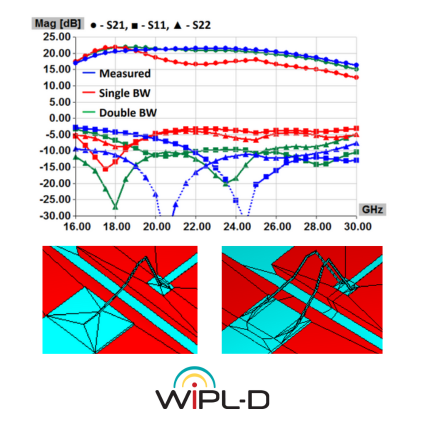
In this application note, accurate modeling of bonding wires is vital for effective use of semiconductor bare dies and achieving high integration in modern microwave front ends.
WIPL-D Microwave Pro offers a unified, versatile environment where EM and circuit simulations efficiently reveal how interconnects impact overall system performance in realistic scenarios. The narrow return-loss bandwidth of single wire bonds is shown through amplifier degradation, while double bonds demonstrate clear, measurable improvement and the reasons behind it. Examples focus on designs near 24 GHz, where interconnect effects intensify and practical compensation techniques or alternative technologies like flip-chip or µBGA must be considered carefully.

View PDF

Dielectric Resonator Filter [Verified by Measurements]

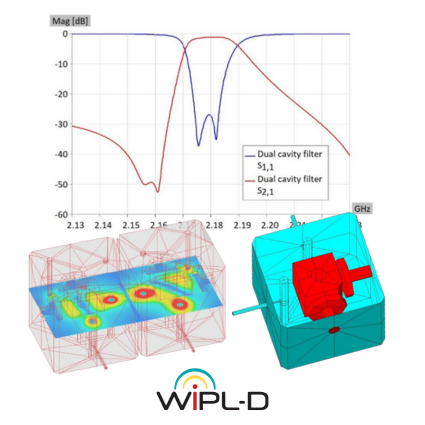
This application note presents the simulation of complex dielectric resonator filters with multiple tuning elements using WIPL-D software. Starting from a single cavity with a coaxial loop, a solid cubic dielectric puck is inserted to modify resonance, followed by a hollow puck for further tuning. WIPL-D Sweeper demonstrates resonance shifts by changing puck length. The single-cavity model, tuned for wide and deep resonance matching measured results, runs in seconds per frequency point using only 11 points thanks to built-in interpolation. Finally, mirrored cavity connected via goal-post configuration is simulated efficiently on a standard desktop or laptop, maintaining fast, accurate, and reliable results across the frequency band.

View PDF

3-Port Wilkinson at High Microwave Frequencies

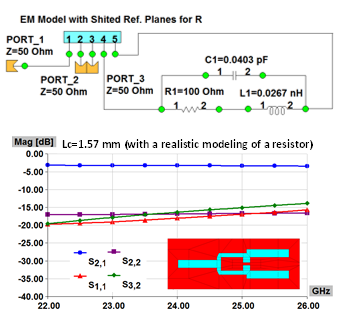
In this note, accurate modeling of high-frequency effects for a Wilkinson power combiner/divider is demonstrated using WIPL-D Microwave, providing a complete circuit and EM co-simulation environment. The design cycle starts with an ideal schematic, progresses to a detailed schematic including microstrip discontinuity models, and then incorporates a full EM component for precise microstrip circuit modeling. Finally, the impact of a real-world resistor is analyzed. Each step’s effect on performance degradation compared to the ideal circuit is illustrated, giving designers clear guidance on mitigating issues early, such as selecting the smallest resistor size and optimizing substrate and line-to-pad length ratios for improved performance.

View PDF