
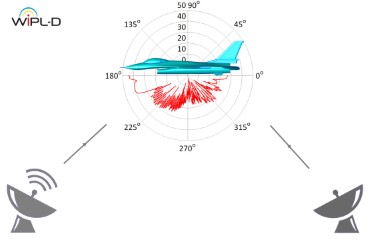
Monostatic RCS of Fighter Aircraft

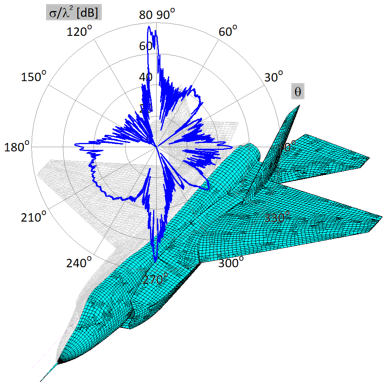
WIPL-D suite enables EM simulation of airplane Radar Cross Section and geometries at high frequencies. WIPL-D Pro CAD allows import from popular CAD formats, model validation, and removal of irrelevant details. Its automated mesher subdivides geometries into quadrilaterals, modeling curvatures and small features while minimizing EM requirements. Simulations use higher-order basis functions, 30 unknowns per λ² for metallic surfaces, and features to reduce unknowns without losing accuracy. CPU/GPU simulations run efficiently on inexpensive hardware. Examples include monostatic RCS of F16 (0.1–3 GHz), F35 (0.1–4 GHz), and F35 at 10 GHz using DDS Solver on multicore, multi-GPU workstations, with simulation times in hours.

View PDF

Full-Wave Monostatic RCS of a Bee

This application note presents efficient monostatic Radar Cross Section (RCS) simulation of a highly detailed CAD model of a bee using WIPL-D Pro CAD, which combines CAD modeling, in-house quad meshing, and a full Method-of-Moments solver. The bee body is modeled as homogeneous dielectric with high Er. The full model, meshed into over 6,000 plates, is carefully simulated on a standard desktop. A simplified model without the long narrow legs shows nearly identical accuracy but is significantly faster. Highly efficient parallelized matrix fill-in and GPU solver enable simulations in minutes for the full model and seconds for the simplified one, supporting even very large and complex problems with 100,000 unknowns on inexpensive hardware.

View PDF

T-72 RCS on Amazon Cloud Server

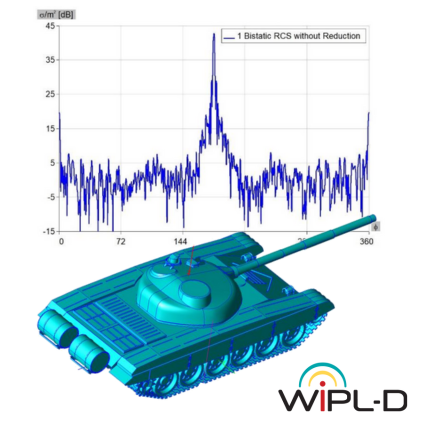
This application note presents bistatic and monostatic Radar Cross Section (RCS) of the T-72 tank at 3.6 GHz (7.4 m long, 89 wavelengths). WIPL-D Pro CAD enables easy import of complex CAD geometries, model validation, and simplification of irrelevant details. After creating a quad mesh optimized for EM simulations, WIPL-D Pro efficiently simulates the model. The focus is usability on an Amazon cloud server with 8 Tesla V100 GPUs, where the software runs without issues. The problem is solved without symmetry; all CAD details are preserved. The incident RCS wave arrives from the backside in the horizontal plane with vertical polarization. Reduction techniques for monostatic RCS are discussed, and simulation times are measured in hours.

View PDF

Detecting Aircraft Shape via SAR

Synthetic Aperture Radar (SAR) uses signal processing to improve resolution beyond the physical antenna aperture. A uniform plane wave excites points in the scattering area, and the target reflects a small portion back to the receiving antenna. For a 12 m long, 8.05 m wingspan fighter aircraft, monostatic RCS is simulated at 76 frequency points (2–3 GHz) and 225 directions per frequency. Two reduction techniques—symmetry and carefully adjusting the referent frequency—significantly reduce unknown coefficients and overall simulation time. The resulting SAR image accurately matches the aircraft’s actual shape, showing
WIPL-D is very suitable for fast and accurate SAR system analysis, executed efficiently on a GPU workstation in about 2 days.

View PDF

The Radar Shadow

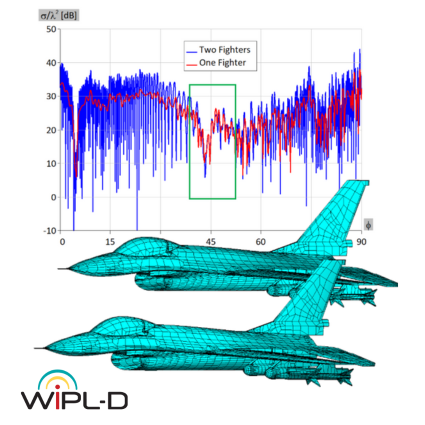
This application note basically presents a monostatic Radar Cross Section (RCS) analysis of a scenario where a surveillance radar actually illuminates a zone with two approaching aircraft. In this scenario, a radar shadow can effectively deceive the radar, making it perceive only one aircraft. The note further explains the necessary CAD manipulations and proper meshing of a fighter aircraft model, followed by additionally adding a second aircraft for the two-aircraft scenario. In this case, one aircraft naturally lies in the shadow of the other for a 45° radar illumination angle. Both scenarios are simulated at 1.3 GHz using WIPL-D software, without applying any reduction of unknowns, and overall achieving acceptable simulation times.

View PDF

Austin RCS Benchmark with WIPL-D Software

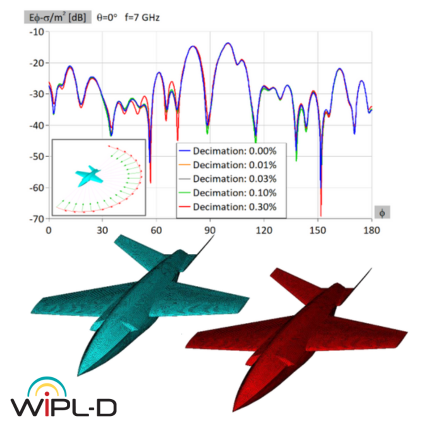
This document outlines several RCS results obtained from three aircraft models simulated at four different frequencies, with the primary goal of verifying the accuracy and reliability of WIPL-D Software by comparing its outputs with the well-known “Austin RCS Benchmark.” The study demonstrates that WIPL-D results show strong agreement with the measurement and simulation data provided in the benchmark, confirming the software’s validity for this class of problems. It is further shown that applying different levels of model decimation can notably reduce overall simulation time while still maintaining a high degree of accuracy, generally highlighting the efficiency and practicality of the workflow for large-scale electromagnetic analysis.

View PDF

Austin RCS Benchmark: PEC Sphere & Plates

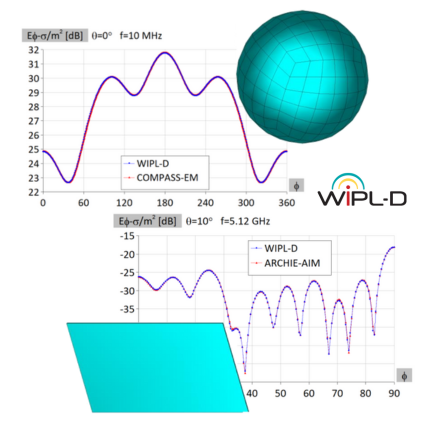
This document presents several RCS results derived from three structures—a PEC sphere, an infinitely thin PEC plate and a PEC plate with 64 mil thickness—simulated at multiple frequencies. These simulations serve to verify the quality of RCS results obtained using the WIPL-D Software suite by comparing them with “Austin RCS Benchmark” data. WIPL-D Software, a full-wave 3D electromagnetic Method-of-Moments (MoM) tool, applies Surface Integral Equations and Higher Order Basis Functions to ensure very high computational efficiency. The results demonstrate that WIPL-D can accurately and efficiently simulate these benchmark models in a reasonable time, using an affordable desktop or workstation computer, without any unnecessary complexity.

View PDF

Single Human Body and Human Crowds RCS

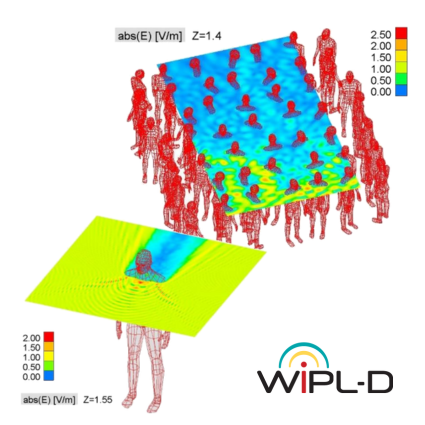
As electronic devices have become integral to daily life, public concern about electromagnetic (EM) exposure has increased. This application note focuses on homogeneous dielectric and equivalent metallic human body models in 2–10 GHz range, with skin depth from 60 mm at 2 GHz to 2 mm at 10 GHz. At higher frequencies, the most efficient simulation model is a metallic body with losses represented by distributed loadings, reducing unknowns without compromising accuracy. Simulations include a dielectric human model at 2 GHz, metallic models with distributed loadings at 2 and 10 GHz, and a human crowd of 49 bodies with random positions at 0.9 GHz, all run on a standard desktop PC with increased RAM and a single GPU for faster matrix inversion.

View PDF

Scattering from Coated Missile

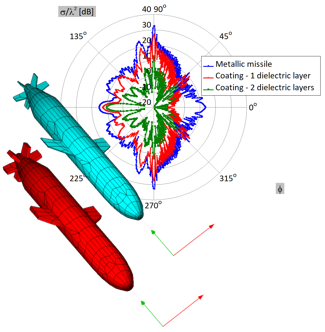
This application note compares monostatic scattering from metallic and coated missiles. Three models were created and simulated using WIPL-D Pro CAD, enabling fast creation of 3D geometries, importing from CAD, or building from scratch with primitives. Dielectric layers were added via Copy/Layer manipulation after meshing, ensuring identical surfaces for geometry and simulation. Models include metallic, single coating, and double coating configurations. Simulations ran on a desktop with a low-end Nvidia GPU, using CPU for matrix fill and GPU for inversion. Monostatic analysis with multiple excitations was performed efficiently, with minimal additional time compared to bistatic RCS simulations, providing reliable results for radar studies.

View PDF

Stochastic Trees

Radar Cross Section (RCS) of trees is important in geosciences, propagation near forests, and radar applications. Full-wave EM analysis of complex structures is challenging due to geometrical complexity and randomness. Decades ago, WIPL-D Pro simulated wire models of stochastic trees using wires of varying radii with distributed loadings. This application note presents advanced meshing algorithm for stochastic tree models with a GPU-accelerated solver. Tree models are fully automated closed surfaces, defined as dielectric with (E_r = 10), overcoming frequency limitations of wire models. Monostatic RCS for trees at 0.2, 0.5, and 1.5 GHz was simulated on inexpensive GPU workstation with short simulation times even at RF frequencies.

View PDF

Synthetic Aperture Radar Systems

Synthetic Aperture Radar (SAR) improves resolution beyond the physical aperture by synthesizing a large virtual aperture through movement. This application note clearly presents efficient numerical analysis of a rail SAR system using MoM-SIE with higher-order basis functions, reduced unknown coefficients, and far-field equivalent sources for fast computation. Simulations run on a multi-GPU platform, with each frequency point on a single inexpensive GPU; 8 GPUs speed up the process roughly 8×. Replacing the real radar antenna with an equivalent far-field source turns multiple transceiver positions into a multi-excitation problem. A 40-wavelength-long airplane illuminated from 101 SAR positions took only ~9 hours instead of 101× longer.

View PDF

Scattering from PEC Spheres

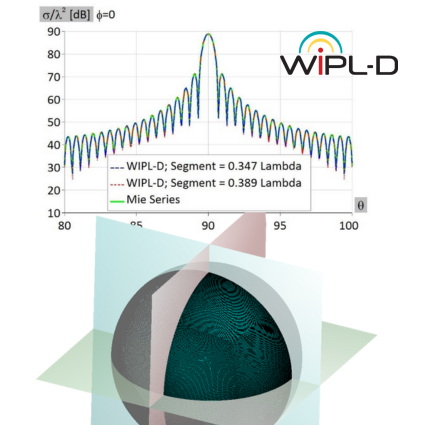
This paper demonstrates bistatic EM scattering from electrically large PEC spheres at 15 GHz using WIPL-D Pro software. Four spheres, each 50 λ in radius, are illuminated by plane wave. To reduce unknowns and simulation time, three symmetry planes are applied. WIPL-D Pro, full-wave 3D MoM solver with higher-order basis functions, is used for modeling and simulation. Results are compared with Lorentz-Mie series, the standard analytical benchmark for canonical geometries. Matrix inversion is performed using WIPL-D GPU Solver. Unlike volume-discretization methods, no artificial boundaries or PMLs are needed. These features ensure high accuracy and computational efficiency, making WIPL-D Pro especially suitable for open-space RCS calculations.

View PDF