
RF Propagation in Mining Tunnels

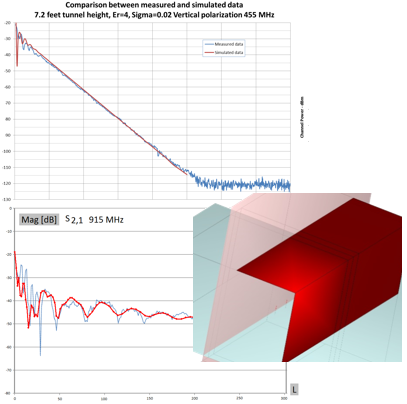
Due to higher-order basis functions, efficient multi-core CPU parallelization, and GPU support, WIPL-D software is ideal for RF propagation analysis in complex underground environments. This includes evaluating power transfer between transmitter/receiver antennas in long underground tunnels, several hundred meters long. Antennas are placed in tunnels with concrete walls (Er: 4–7, σ: 0.02–0.0002), height 7.2 ft, width 6 ft. Simulations cover 455 MHz and 915 MHz, considering both horizontal and vertical polarization. Measured and simulated data are compared for distances up to 500 ft. WIPL-D enables accurate, efficient RF propagation simulations in complex environments, supporting advanced analysis and design validation.
View PDF

Unmanned Aerial Vehicle (UAV) Simulation Scenarios

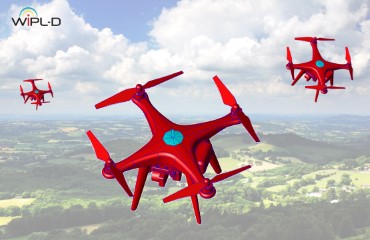
In this application note, real-life scenarios with three payload-carrying drones flying in line formation and communicating around 2.4 GHz are investigated, focusing on electromagnetic effects within the physical layer of their communication link. The reference case places the drones above an infinite PEC ground plane, while additional scenarios introduce a metallic wire fence between two drones, modeled in different ways. The results clearly show that both the presence of the fence and the chosen modeling approach affect the S-parameters between antenna ports. All simulations are performed efficiently using WIPL-D, demonstrating that the software reliably supports detailed analysis of drone-related scenarios with consistent accuracy.

View PDF

Time-Domain EM Reflectometry in Coaxial Cables

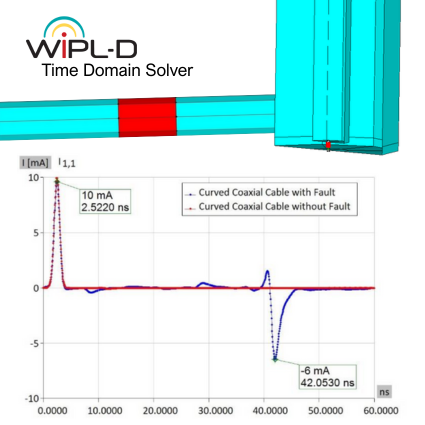
This application note demonstrates how WIPL-D Pro, a 3D EM simulation software, combined with the WIPL-D Time Domain Solver (TDS) module, can perform accurate time domain reflectometry simulations. TDS calculates the time-domain response using frequency-domain simulation and Fourier transform, fully integrated in WIPL-D Pro. Reflectometers locate and characterize coaxial cable discontinuities, such as faults in airplane wiring, with spread spectrum TDR for precise fault detection. Three cable models were simulated: a straight cable with a fault, a plain curved cable, and a curved cable with a fault (frequency-dependent dielectric). WIPL-D simulations accurately match theoretical fault locations, proving speed, accuracy, and reliability.

View PDF

Convergence Study & Kernel Settings for Microstrip Patch Antennas

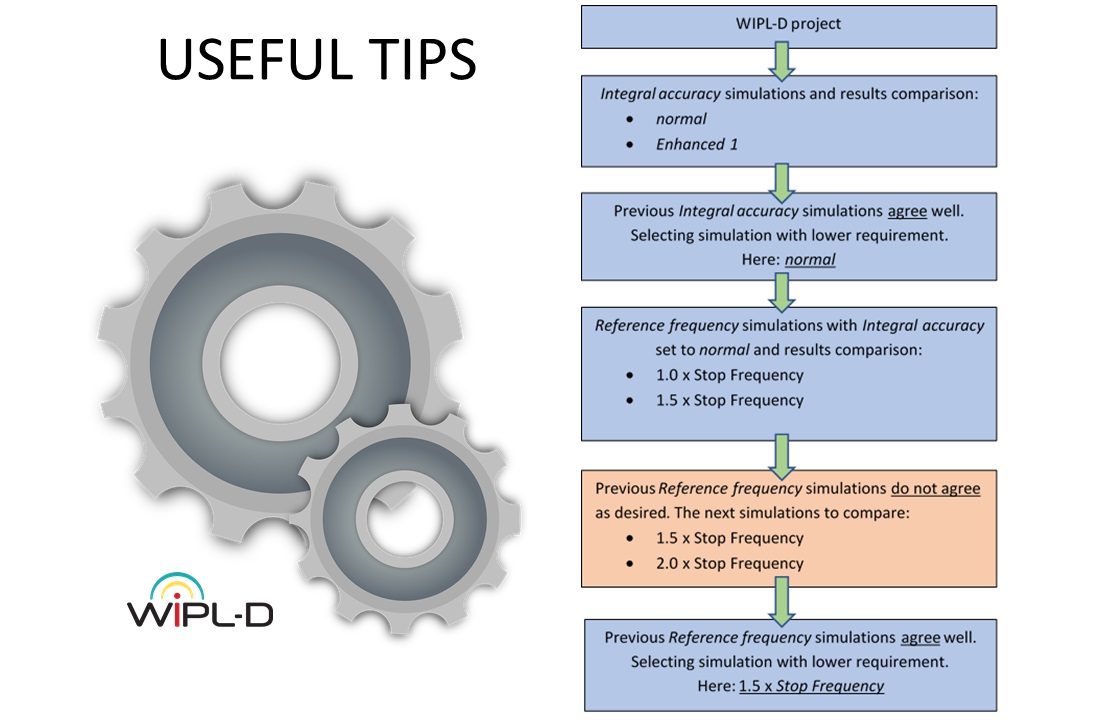
An example of the convergence study of calculated S-parameters is presented in this note, using WIPL-D Pro CAD, a full-wave 3D EM MoM software. The model is described as a microstrip patch antenna operating near 2.4 GHz, and all conclusions are applied to many components in this heavily used band. The note shows how convergence is examined for commonly simulated EM models by gradually increasing Integral Accuracy and Reference Frequency, while Edge-ing is recommended for printed structures. It is shown that adjusting numerical settings greatly improves result convergence, though at the cost of longer simulation time and more unknowns, which becomes important when dealing with electrically large or detailed designs.

View PDF

Frequency Selective Surface

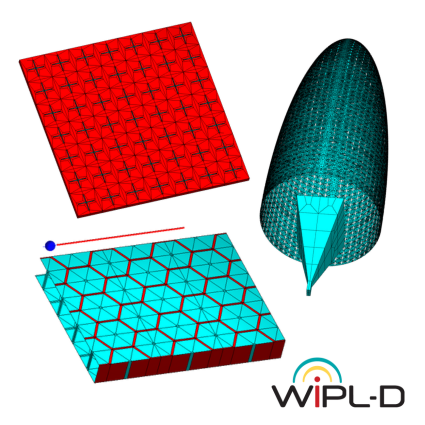
There is a growing demand for new materials to enhance device performance at low cost. Numerous studies built from many uniform cells clearly demonstrate that such challenging engineering problems can be addressed and analyzed using WIPL-D software. Demonstrated cases include dipole radiation modified by nearby FSS at 13 GHz, coupling between dipoles over FSS (calculable even below –100 dB), RCS from FSS on dielectric slabs (7×7 cells), energy transfer through FSS (achieving additional 30 dB isolation), and a rectangular horn covered with metallic FSS radome. All models run smoothly on standard desktop PC equipped with an inexpensive GPU card, with simulation times under one hour even for the most complex and realistic practical scenarios.

View PDF

Wire Equivalents of Antenna Standoffs

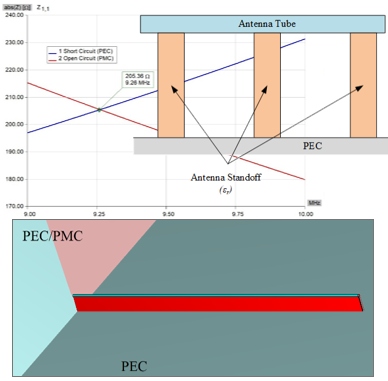
This application note presents an efficient technique to determine equivalents of antenna dielectric standoffs using wires with distributed loadings. The capacitive coupling of the antenna tube with the ground is characterized by capacitance per unit length. Each dielectric standoff can be emulated by a wire with proper radius and distributed loading, determined by the standoff’s cross-section and relative dielectric constant. Using reverse engineering, the dielectric constant can be accurately emulated if the capacitance per unit length is known. For fast simulation and optimization, replacing dielectric standoffs with wires is highly effective. Results obtained with WIPL-D closely match theoretical predictions, confirming the concept.

View PDF

Log-Periodic Dipole Antenna in AW Modeler

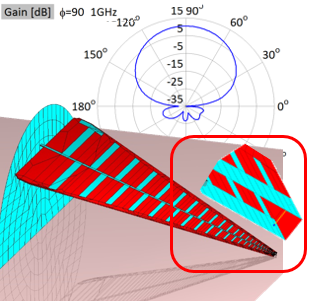
A log-periodic dipole antenna (LPDA) with 52 printed dipoles was created in WIPL-D AW Modeler and simulated in WIPL-D Pro. Symmetry and edge manipulation were applied, while other parameters remained at default settings. The antenna is approximately 261 mm long and positioned 4.25 mm from a metallic circular plate with a 248 mm diameter. The longest dipole arm measures about 76.2 mm, while the shortest is around 1.53 mm. Simulation times and the number of unknowns for LPDA operation from 1 GHz to 18 GHz are presented in the application note. All simulations were performed on a standard desktop PC using a low-end NVIDIA GPU to accelerate matrix inversion, with accurate and efficient results for wideband antenna design validation.

View PDF

WIPL-D 2-D Solver

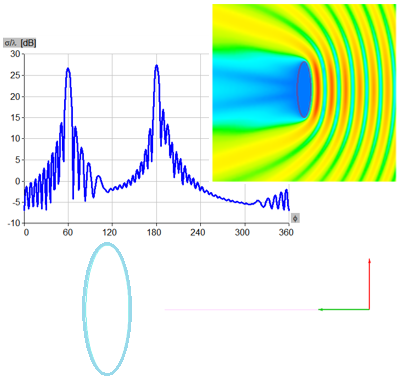
WIPL-D 2-D EM Solver is designed for numerical analysis of theoretically infinitely long cylindrical structures, using 2-D cross-sections. Its engine employs surface integral equation formulations, applying electric field integral equations for metallic structures and PMCHWT for dielectric and magnetic materials, supporting combinations of piecewise linear materials and arrangements of infinitely or finitely thin layers with distributed loadings. Examples include computing the near field around a PEC elliptical scatterer, demonstrating complex 3-D structures with a tool for extracting cross-sectional cuts, and performing a 12-decade frequency sweep of backscattered RCS from a perfectly conducting cylinder with a 1 m circular cross section.

View PDF

WIPL-D Optimizer

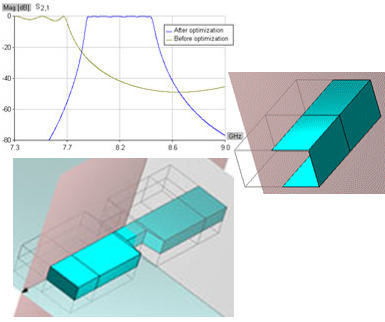
WIPL-D Optimizer is a powerful multi-algorithm optimization tool used by many professionals worldwide, capable of calculating single or multiple solutions for complex, multi-criteria optimizations efficiently and accurately in various engineering applications and designs overall. Its simple, intuitive graphical interface allows problems to be solved quickly. Built-in algorithms include Particle Swarm, Genetic, Simulated Annealing, Random, Gradient, Systematic, and Simplex, with a unique feature allowing two optimization procedures with different algorithms to run in succession—first for coarse optimization, then for fine tuning. Examples of its application include optimizing horn antennas and automating the design of waveguide filters.

View PDF

Handheld Device Antenna Radiation Patterns & VSWR

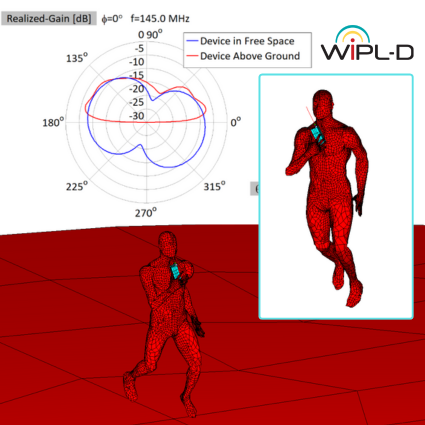
In this application note, four scenarios involving a handheld communication device in real-life environments are analyzed, focusing on VSWR and radiation pattern (absolute gain). When modeled in an operator’s hand, the VSWR minimum shifts downward, indicating a different current distribution than in scenarios without human interaction. Introducing a real ground modifies the radiation pattern compared to free space, while placing the device in a human phantom’s hand has an even stronger effect; adding a clump produces negligible change. Despite the VSWR shift, realized gain across all ground-included scenarios remains largely unchanged due to low VSWR values (<2.0). All simulations were completed efficiently on an affordable workstation.

View PDF

Microwave Tomography in Biomedicine using (A)Symmetry

This application note explains the asymmetry feature in WIPL-D, allowing users to model half, quarter, or one-eighth of a structure by setting asymmetry planes and adjusting generator voltages (default equal amplitudes). WIPL-D then automatically finds the minimum number of simulations needed using PEC and PMC planes. This reduces unknowns 2×/4×/8× and simulation time up to 4×/16×/64×, especially for larger problems, enabling less powerful licenses to efficiently handle very complex structures with accuracy. Simulations run efficiently on inexpensive hardware with GPU support. Examples include a circular dipole array, a canonical PEC cuboid, and a realistic 3D microwave tomography system, demonstrating fast, accurate UWB simulations.

View PDF