
Direction Finding Antenna (DFA)

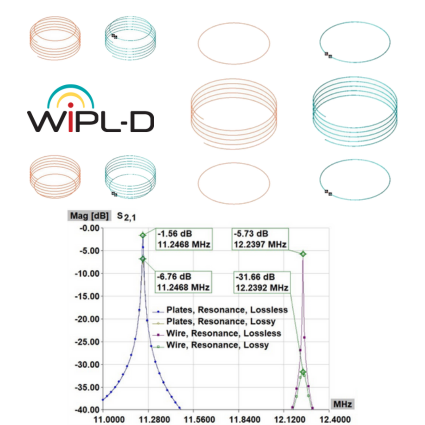
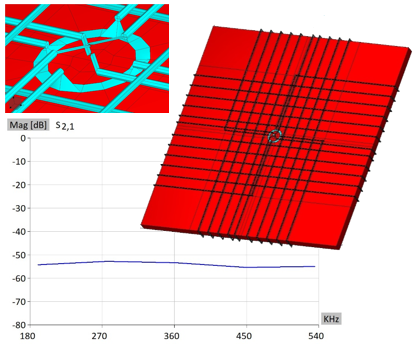
A magnetic antenna system patented by G. Wennerberg can be efficiently used as a direction-finding antenna (DFA). It is especially suitable for mounting on aircraft as it has no moving parts. This application note presents detailed simulation results and analysis for an electrically small DFA comprising two coils wrapped around magnetic material in orthogonal directions. The smallest mesh element is about 0.2 mm, ~1/8,000,000 of wavelength. The DFA was simulated using WIPL-D Pro, a full-wave 3D EM solver based on method-of-moments (MoM). Results show MoM can simulate extremely small, low-frequency structures accurately. Coupling between ports remains precise down to -60 dB, and simulations run efficiently on a standard desktop or laptop.
View PDF

On-Chip Capacitances

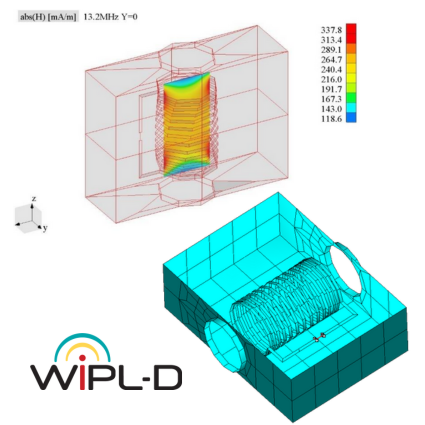
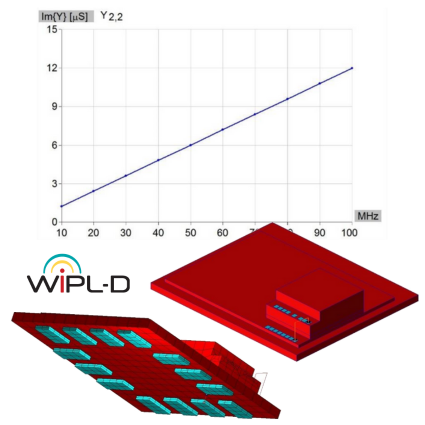
This report describes the use of WIPL-D Software for analyzing self-capacitance and capacitances between pads and connecting wires on a small chip (2–3 mm). The frequency range is 10 kHz to 10 MHz, representing an extremely low-frequency problem. WIPL-D Pro, a 3D EM method-of-moments solver, is typically for high frequencies but can handle low frequencies accurately with careful modeling. The chip can be modeled in WIPL-D Pro using wires, plates, or objects, or in WIPL-D Pro CAD with solid bodies and automatic meshing. Device behavior is linearly proportional to frequency, allowing low-frequency extrapolation. Double precision ensures highly accurate results on a standard 4-core desktop, with simulations completed in several minutes.

View PDF

Wire Thickness Effect in Wound Coils

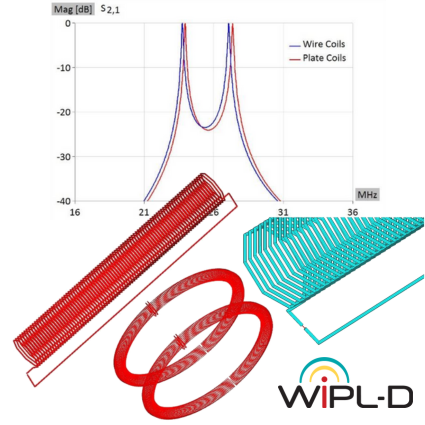
This note examines the effect of wire thickness on electromagnetic simulation accuracy of wound coils. Two classes are considered: straight and toroidal coils. Coils are modeled in WIPL-D using two approaches—wires or plates. Wire models use a thin-wire approximation, assuming current varies only along the wire axis, making simulations fast but potentially less accurate. Plate models consider all current components and are more demanding. Results show thin-wire models produce nearly identical results to plate models, making them reliable for most cases, significantly reducing simulation time and computer requirements. Accuracy may decrease at higher frequencies or denser windings, but all models run efficiently on a desktop.

View PDF

Fast and Accurate Simulation of Wireless Power Transfer

This note explains how an inductive power transfer (WPT) link can be simulated using WIPL-D Pro CAD software tool. Two helical resonators are coupled to input and output loops. Only boundary surfaces need meshing, so simulations of the four-inductor structure are fast. Convergence is verified by calculating the resonant frequency of a helical inductor identical to that used in WPT. Once optimal meshing is set, speed and accuracy are ensured. Solid (plate) inductor models provide high accuracy, while thin wire approximations are insufficient. Port impedances can be varied to optimize generator and source. Results agree with literature. All calculations were performed on a standard desktop PC, with simulation time per frequency  around 5 minutes.

View PDF

Buried Objects Detection via Magnetic Loop

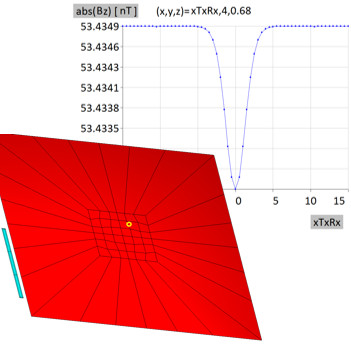
This application note describes the use of WIPL-D software for simulating the coupling between a buried object and a magnetic loop above the ground. Variation of coupling with loop movement can be effectively used to detect buried metal objects. Simulations were carried out using WIPL-D Pro, a full-wave 3D EM MoM solver, offering excellent speed, high accuracy, and reliable results even at extremely low frequencies. The scenario involves a thin aluminium plate 3 m underground, with a magnetic dipole 2.2 m above, swept over the plate to examine changes in the magnetic field. The loop is circular with a 0.33 m radius and moved within [-15 m, 15 m]. Fewer than 500 unknowns allow fast simulations in 1–2 seconds on a standard desktop or laptop.
View PDF

Modeling Wires in Planar Spiral Coils

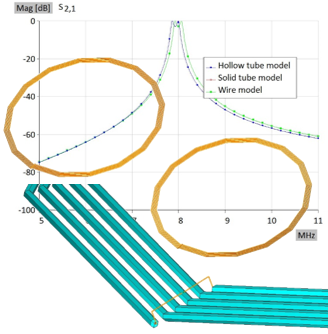
This note presents efficient WIPL-D simulations at low frequencies, particularly 5–10 MHz range. Planar spiral coils can be modeled accurately using two main techniques: a thin-wire approach, which assumes a constant circular current that varies along the wire axis, or a method based on quadrilateral plates. These coils are easy to construct using built-in spiral or helix objects and may be represented as thin wires, solid conductors, or hollow tubes. WIPL-D Pro CAD, an advanced 3D EM solver based on the Method of Moments, employs quadrilateral meshing with higher-order basis functions. The resulting simulations are fast and precise, showing comparable accuracy for hollow and solid models, while all computations run efficiently on a standard desktop.

View PDF

Coil with Continuously Variable Pitch

The models of a coil with continuously variable pitch were created using WIPL-D electromagnetic simulation software. WIPL-D Pro CAD was used to create the model, while WIPL-D Pro 3D EM solver executed the simulations. In WIPL-D Pro, the predefined Helix primitive can directly model a helix, coil, or spiral inductor, but for non-uniform winding or specifications, WIPL-D Pro CAD is more convenient. The modeling process involves setting symbols, creating the wire per specification, sweeping a cross-section profile, and placing the coil into a metallic frame with feeding wire added. Simulation with finite metallization thickness typically lasts a few seconds frequency on a standard desktop or laptop, and is shorter if thickness is neglected.

View PDF

Inductive Wireless Power Transfer for Phone Charging

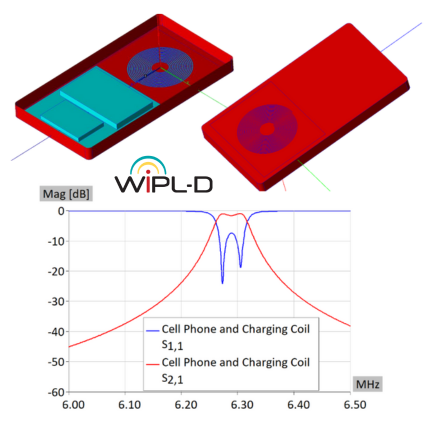
Wireless Power Transfer (WPT) involves transmission of electrical energy from a power source to a load without using conductors. In this note, a near-field WPT example, or Inductive Wireless Power Transfer (IPT), is considered. Coil models and results for a power charging scenario using the coils are explained. A real-life scenario demonstrates how a smartphone can be charged using a pad, with realistic distances from a few millimeters up to a meter. Only radio frequency (RF) aspects are investigated to draw conclusions. S-parameters calculated using an EM simulator are presented. WIPL-D software, a full-wave 3D EM MoM solver, is used for versatile geometry modeling and simulations, remaining efficient on standard inexpensive hardware.

View PDF

Verifying Accuracy for Inductive Loops with Lumped Elements

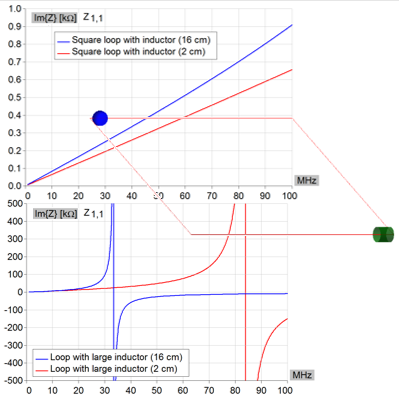
This application note aims at explaining the analysis of simple wire loops (inductive in their nature) in the WIPL-D software package, with special attention devoted to the case when lumped elements are also included in the circuits. A simple wire square loop is analyzed at 15.9155 MHz, and two loops are simulated with total circumferences equal to 2 cm and 16 cm. The accuracy of EM simulation can be easily verified by checking the obtained values using a number of free calculators available on the Internet, which give almost the same values as WIPL-D. These results illustrate the accuracy of WIPL-D in determining low-frequency inductance, and the simulation accuracy is verified with the same loops to which a lumped element is attached.

View PDF