
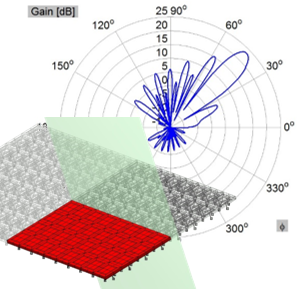
Active Electronically Scanned Array (AESA)

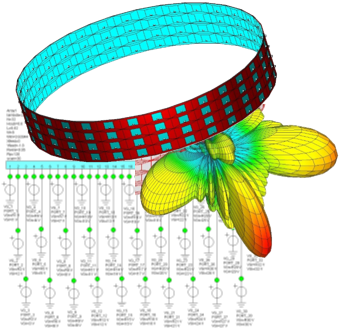
Microwave engineering often focuses on designing antenna arrays for satellite and mobile systems, where AESA architecture enables rapid electronic beam steering without mechanical movement. WIPL-D Pro, as a full-wave MoM solver, employs higher-order basis functions, quadrilateral meshing, efficient CPU/GPU acceleration, and smart symmetry handling to analyze large arrays. With asymmetric excitations, users can assign different voltages to elements for multiple steering angles without re-running the EM simulation. A typical example is a 128-element stacked patch array with three dielectrics and four coaxial probes per element, which runs in just a few minutes on a standard desktop PC while delivering stable, consistently accurate results.
View PDF

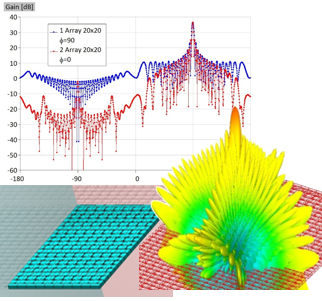
Waveguide Slot Array 20x20

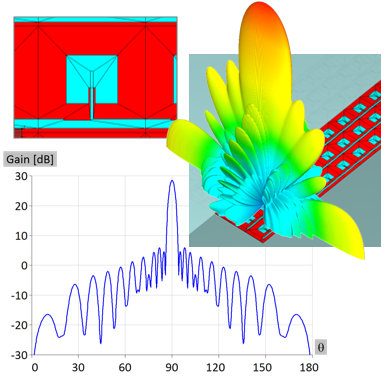
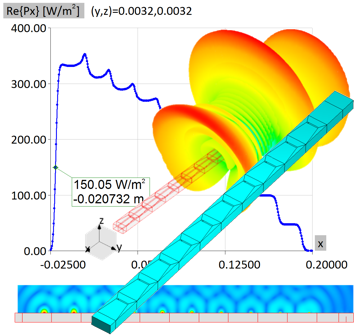
This application note presents efficient simulation of a large waveguide slot antenna array using WIPL-D Software. The 400-element structure, with 800 shifted slots, is modeled and analyzed in WIPL-D Pro. To reduce computational demands, two symmetry planes are applied, so only a quarter of the array is simulated at 34 GHz. The simulation runs on a standard desktop PC with a single low-end GPU card, where matrix inversion is carried out on both CPU and GPU. The note highlights clear speed improvements when using the GPU solver, while each two-slot element requires roughly 200 unknowns, demonstrating reliable performance even under demanding electromagnetic scenarios and highly practical engineering conditions used widely today overall.

View PDF

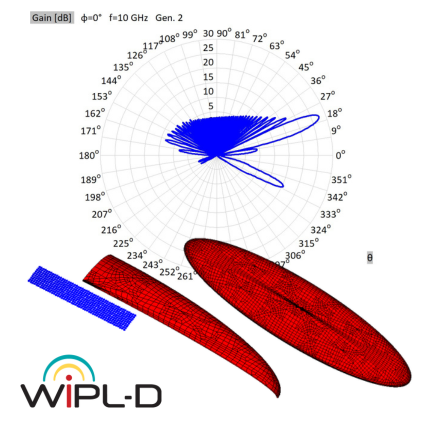
Steering Array under 100 Lambda Radome via FGs

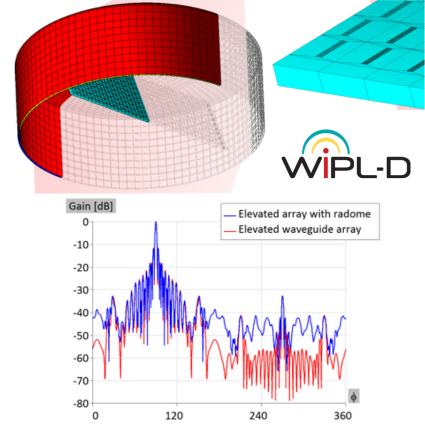
The primary function of a radome is to protect an antenna system from the environment with minimal impact on electrical performance. For electrically large radomes, analytical and asymptotic techniques are often used, but higher accuracy is required. WIPL-D’s advanced MoM implementation with inexpensive GPU platforms and Field Generators enables such simulations. Modeling a generic-shaped radome is fast using WIPL-D Pro CAD, and multiple layers are added in seconds via copy layer manipulation. The 100 λ-long array radiation is steered across the surface, and field generators reduce unknowns. Simulation doubles for any number of directions, allowing a 100 λ quasi-ellipsoidal radome with one or three dielectric layers simulated in hours.

View PDF

Radome Boresight

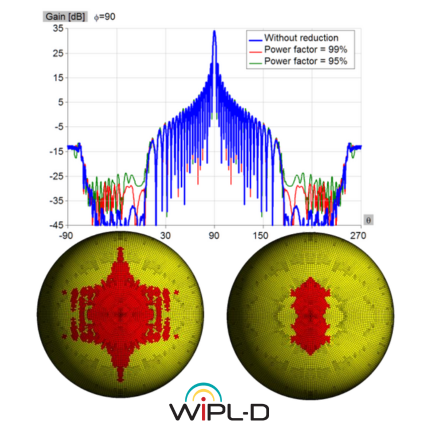
In realistic antenna placement problems, outdoor-mounted antennas are often covered with radomes, which should minimally affect performance. WIPL-D has significant experience in simulating electrically large radomes, and its MoM-based WIPL-D Pro solver is ideal for such tasks and practical real-world scenarios, especially for complex industrial and research applications. Radomes measuring hundreds of wavelengths demand heavy computation, so WIPL-D offers techniques to reduce unknowns; For exampleusing inexpensive GPU platforms and the Run Radome feature, parts with negligible influence are identified and excluded, controlled by the user. Results show reductions in mesh elements, unknowns, and simulation time without compromising accuracy.

View PDF

Microstrip Patch Array with Feeding Network

Microstrip patch antenna arrays are used to achieve larger antenna gain and enable precise beam steering. In EM simulation, such arrays require more sophisticated numerical approaches and hardware for highly accurate results. A microstrip patch antenna array with feeding network is simulated using WIPL-D Pro, a MoM-based full 3D EM solver. This is possible thanks to higher order basis functions and quadrilateral mesh elements, allowing efficient and highly accurate modeling and reliable performance prediction. Simulation is carried out on a standard desktop PC, with execution parallelized across multicore CPUs. Using a low-end GPU card further improves speed. The array in this note is small or moderate, while large arrays may include hundreds of elements and connections.

View PDF

Radome Run Applied to Transparent Radome over FGs

In realistic antenna placement problems, outdoor-mounted antennas are often covered with radomes, which should minimally affect performance. WIPL-D has significant experience in simulating electrically large radomes, and its MoM-based WIPL-D Pro solver is ideal for such tasks and practical real-world scenarios, especially for complex industrial and research applications. Radomes measuring hundreds of wavelengths demand heavy computation, so WIPL-D offers techniques to reduce unknowns; For exampleusing inexpensive GPU platforms and the Run Radome feature, parts with negligible influence are identified and excluded, controlled by the user. Results show reductions in mesh elements, unknowns, and simulation time without compromising accuracy.

View PDF

Large Patch Array behind Car Bumper

This application note demonstrates the performance of WIPL-D for very large arrays of microstrip patch antennas. The finite-ground array has over 150 elements, simulated at 70–80 GHz (77 GHz). The array is placed behind a metallic grill immersed in plastic, mimicking a car bumper. A simplified formula estimates unknowns: ~124,000 for the array, 190,000 with the grill, and 290,000 including the plastic at 32 GHz reference frequency. Simulations run on an inexpensive multi-core CPU server with four low-end Nvidia GTX GPUs, completing in a couple of hours. The Domain Decomposition Solver (DDS) efficiently handles high-frequency problems, with fully convergent results after iteration #4 of 15, all showing excellent accuracy in under an hour.

View PDF

12x12 MPA Array Covered with Flat Radome

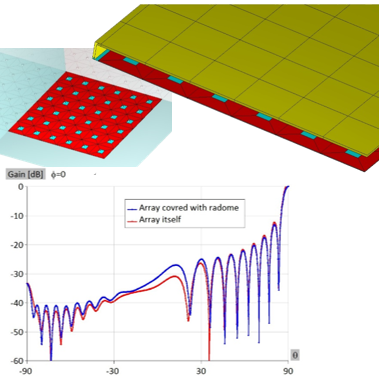
This application note presents how to use WIPL-D Pro as an efficient tool for full 3D EM simulation of arrays of microstrip patch antennas. The array consists of 12×12 elements, and using symmetry the problem can be reduced to a quarter of the full EM simulation (6×6 elements). The array is built on 0.5 mm thick FR4 substrate (Er = 4.3, TgD = 0.02), with spacing of 1.5 wavelengths, patch size 0.45 wavelengths, and feeding point offset 0.3 patch length. The antenna is covered by a flat dielectric radome, 2.3 mm thick (Er = 3.2, TgD = 0.025), placed 0.5 wavelengths away from the antenna surface, ensuring accurate results. The PC is a regular desktop with inexpensive GPU and extra RAM; all simulation times are just a couple of minutes, even with the radome included.

View PDF

Large Multilayer Radomes

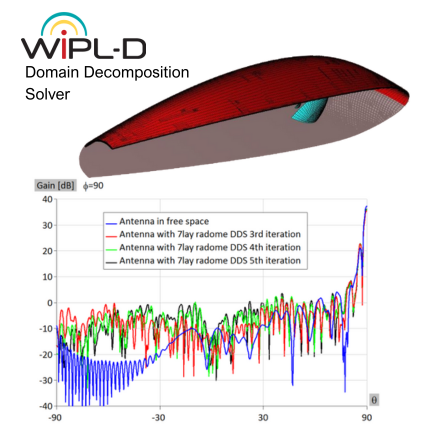
Electrically large multilayer radomes are an important part of realistic antenna structures. They are simulated using full 3D electromagnetic software—WIPL-D—which efficiently exploits CPU multi-threading. This application note shows that the number of unknowns can be significantly reduced using WIPL-D built-in techniques without affecting accuracy. Typical reductions are several times, e.g., a smaller 3-layer radome sees over 3× reduction. The Domain Decomposition Solver (DDS) enables very large radome simulations, achieving fine accuracy from the 4th iteration compared to full-wave MoM. Using DDS, a 7-layer radome with over 2 million unknowns can be efficiently simulated on a moderate CPU platform, beyond the reach of standard MoM.

View PDF

Microstrip Patch Array Printed on Cylinder

This application note demonstrates efficient modeling and simulation of an array using WIPL-D software (Pro, Microwave, Optimizer). The radiation pattern of the array is studied in detail. After optimizing the single patch, the array is created via WIPL-D Pro Manipulations. Full 3D EM simulations are performed only once in co-simulation; each subsequent optimization cycle lasts under 2 seconds, allowing numerous iterations to adjust the main lobe precisely and suppress side lobes effectively. All simulations were carried out on a standard desktop PC, and the WIPL-D GPU Solver, combined with a low-end Nvidia GPU card, accelerates matrix inversion, ensuring fast, accurate, and reliable results for electrically moderate and large models.

View PDF

Waveguide Slot Array

Slotted waveguide arrays consist of multiple slots cut into the waveguide walls, with each slot acting as an individual radiating element. The design here is a 10-element transversal slot array cut into the upper wide side of a WR-51 rectangular waveguide, operating at the center of the K band, 8.5 GHz. A single slot model requires only 231 unknowns thanks to higher-order MoM in WIPL-D Pro 3D EM Solver. The array is built by copying the single slot model nine times, resulting in 1149 unknowns. Simulation of a single slot takes under a second on a standard desktop PC or low-end laptop, while the full array simulation completes in just a few seconds, demonstrating excellent efficiency, precision, and computational reliability overall.

View PDF

Spherical Radome over Circular Horn

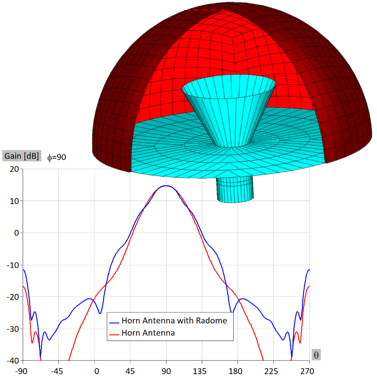
Radome is an enclosure that protects a radar antenna while introducing minimal influence on its performance. Ideally, it should be transparent to electromagnetic waves passing through it, so radome and antenna are typically analyzed as a single integrated system. In this application note, a demo radome and a circular horn antenna are simulated in WIPL-D Pro, a full 3D MoM-based EM solver. The monolithic radome model covers a simple horn, and the goal is to illustrate how quickly and accurately such structures can be analyzed. The operating frequency is 9.5 GHz, and all simulations run on a standard desktop PC in just a few seconds, clearly showing how the thin dielectric radome simply mainly affects lower levels of the radiation pattern.

View PDF