
Obstacle Detection with 77 GHz Automotive Radar

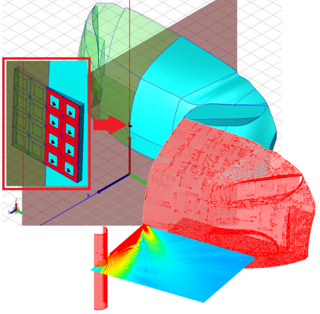
One typical application of EM tools in the automotive radar industry is accurate prediction of the radiation pattern of a radar antenna mounted on the front of a car. Near-field distribution in front of the car shell, often with obstacles, is also crucial. This application note demonstrates DDS capabilities at 77 GHz. The anti-collision radar is modeled as a 4×4 patch array mounted on the car’s front shell. EM simulations were performed on a powerful desktop with 2 12-core CPUs and ample RAM. After a convergence study, the first DDS iteration was found to provide excellent accuracy. Results give insight into radiation patterns and near-field effects of obstacles on the bumper-mounted antenna. All simulations were completed in under 1 hour.
View PDF

Antenna Placement Reduction Applied to Frigate Warship

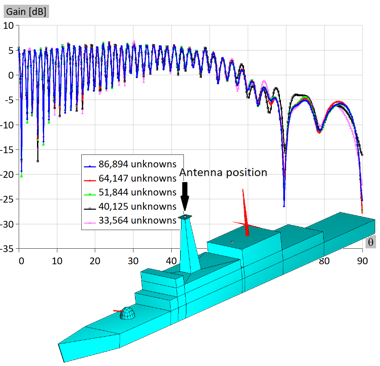
This note presents Smart Reduction, a WIPL-D Pro feature, demonstrated on a frigate warship model. Smart Reduction is ideal for antenna placement problems, reducing current expansion order on parts of the model distant from the antenna or in shadow, lowering unknowns while maintaining high accuracy for radiation patterns and coupling between antennas. The frigate is 117 m long and 12.6 m wide, above a PEC plane modeling the sea, with a monopole atop a 24 m-high communication tower at 240 MHz. Unknowns were reduced about 2.5× without discrepancies. A 94-wavelength-long frigate is modeled with 33,564 unknowns and simulated in minutes on a desktop PC, where a single inexpensive GPU can accelerate simulation time.

View PDF

Full-Wave EM Simulation in Automotive at 24 and 40 GHz

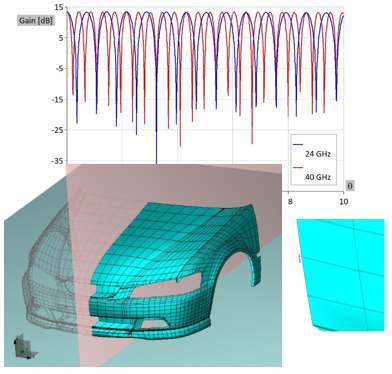
The use of WIPL-D, a 3D electromagnetic (EM) full-wave method-of-moments (MoM) software suite, for simulation of automotive applications at 24 and 40 GHz is described. This clearly illustrates a typical application in automotive industry, predicting radiation patterns of radar antennas mounted on cars. High frequencies create electrically large car models, making simulations very demanding. A realistic car shell was imported into WIPL-D Pro CAD, prepared with repair, meshing, and antenna positioning features. Simulations used the GPU module, while WIPL-D smart features enabled efficient computation with negligible loss of accuracy. Antenna placement and shadow reduction decreased unknowns far from or not directly illuminated by the antenna.

View PDF

Parabolic Dish near Wire Crane

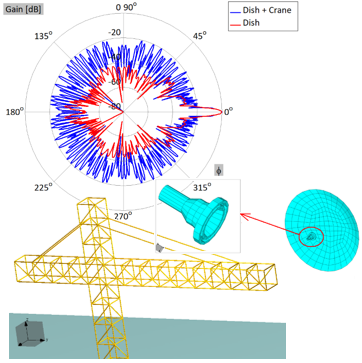
This application note examines the influence of a crane on the radiation pattern of a parabolic dish antenna. Using Wire entities as building elements enables very efficient modeling of wire-like structures, such as the crane, with far fewer unknowns than equivalent all-plate models. Two models are investigated: a solitary dish antenna above a perfectly conducting ground plane, and the dish antenna near a crane above a perfectly conducting ground plane. The parabolic reflector diameter is 3.57 m, fed by a dual-mode horn with a choke, designed for 2.8 GHz. The crane is 30 m high with 28 m long arms. Radiation patterns with and without the crane are compared, with simulations performed on a desktop PC or laptop, lasting seconds both models.

View PDF

LPDA Immersed into Ice

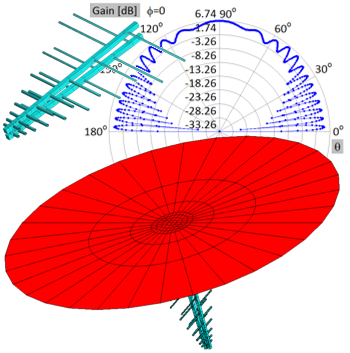
This application note demonstrates the full-wave WIPL-D Pro 3D EM solver for accurate simulation of an LPDA antenna placed below an infinite ice sheet. Radiation calculations above and below the ice are handled carefully by splitting the simulation into two parts. The first calculates forward radiation into the ice, by solving an inverse problem with the antenna positioned above the surface and air below. Then, a special feature computes the reflection coefficient from infinite earth for radiation into the ice. Large clump simulations can run on standard workstations with inexpensive CUDA GPUs; a single GPU suffices. Simulation time ranges from just a few seconds for minimal clumps to about 1 h for the largest clump to confirm convergence.

View PDF

Antenna Placement on Electrically Large Platforms

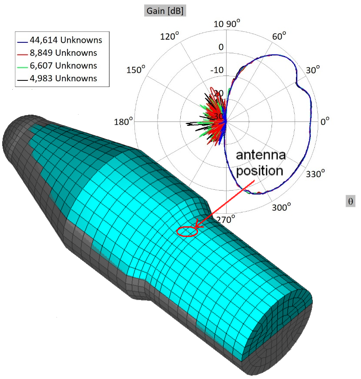
WIPL-D Pro is a frequency-domain MoM code enabling EM simulation of arbitrary 3D structures. MoM requires far less memory and time for open-region problems on PCs or inexpensive workstations. WIPL-D offers parallelization on CPU/GPU platforms. Matrix fill-in is sped up on multithreaded desktops, while matrix inversion for problems uses WIPL-D GPU solver. Features for antenna placement include “smart reduction” or shadow region, reducing unknowns 3–10× while preserving accuracy for engineering applications. A λ/2 dipole is above a payload fairing (8.66 m, ~58 λ at 2 GHz). With one symmetry plane, the model requires 44,614 unknowns; after reductions, only 5,000 unknowns are needed (9× reduction), with side-lobe discrepancies below –25 dB.

View PDF

Planar Inverted-F Antennas in Free Space and Cell Phone

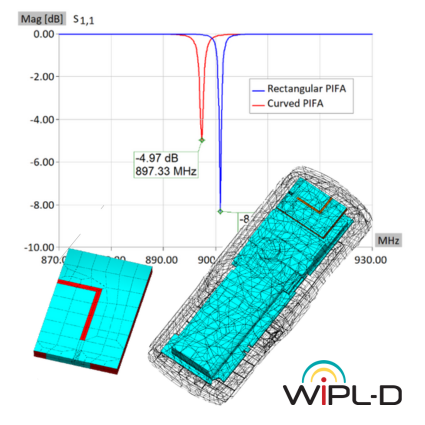
Planar Inverted-F Antenna (PIFA) is widely used in cell phones and tablets. In microstrip technology, PIFA is more compact than the patch antenna, making it a favored choice for mobile antenna designers. This note demonstrates simulations of two scenarios: PIFA in free space and PIFA mounted on cell phone boards (antenna placement). Rectangular and curved PIFAs are used, designed for dual-band operation at ~0.9 GHz (lower) and 1.8 GHz (higher). WIPL-D software, especially WIPL-D Pro and WIPL-D Pro CAD, a full-wave 3D MoM solver, is used for modeling and simulating these scenarios on inexpensive hardware. Results include S-parameters and radiation patterns, showing WIPL-D’s suitability for complex antenna-cell phone simulations.

View PDF