
Coaxial Fed Dipole Mounted on F-16 at 1.9 GHz

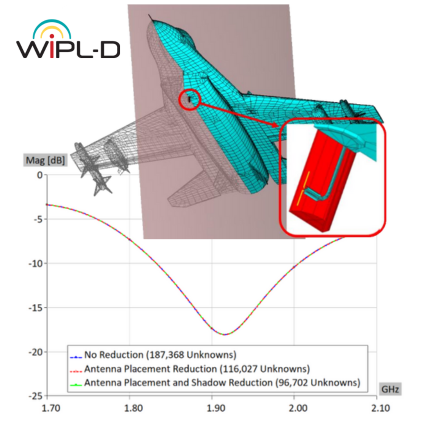
Three models of an IFF dipole antenna with a balun, covered with a dielectric radome and mounted on an F-16 fuselage, were simulated using WIPL-D software. The first model has no reductions, while the other two use antenna placement and shadow reductions. All simulations run fast, with matrix inversion accelerated by inexpensive GPU cards. Results show WIPL-D can efficiently simulate electrically large platforms (~105 wavelengths) with dielectric included. Despite the large aircraft and small feeder (coaxial diameter 3.16 mm, ~45× smaller than wavelength), simulations are accurate. Proper reductions preserve accuracy while reducing simulation time, allowing return loss analysis over a wide band with few points using built-in interpolation.
View PDF

Anti-Collision Radar on Car Bumper

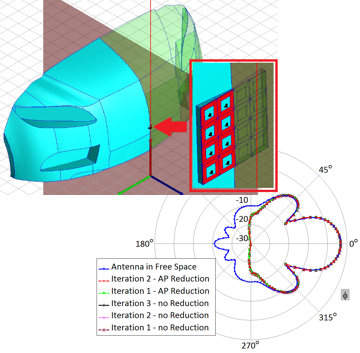
Anti-collision systems, or collision avoidance systems, are advanced safety features in modern cars that detect potential danger and reduce the likelihood or severity of vehicle collisions. In this application note, we consider an anti-collision system using a 77 GHz radar mounted on a car bumper. Simulations are performed using Domain Decomposition Solver (DDS),
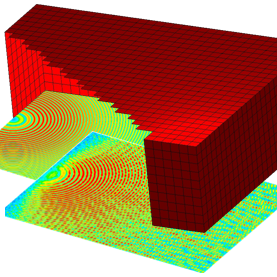
WIPL-D’s highly efficient and reliable tool for electrically very large problems. The radar is modeled with a 4×4 patch array. The bumper was imported into WIPL-D Pro CAD, and the array carefully added to emulate a realistic real-world antenna placement scenario. All simulations ran on a desktop with two 12-core CPUs and ample RAM, with all runs completed in under 1 h using DDS.

View PDF

RF Antenna Coupling on Realistic Platforms

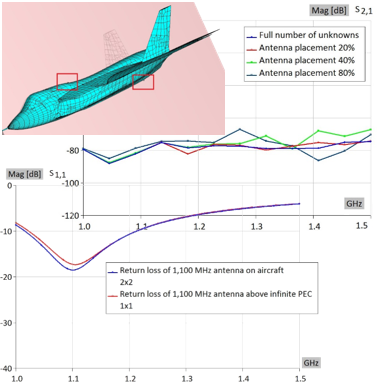
WIPL-D Software Suite emphasizes accuracy with a frequency-domain Method of Moments (MoM) code, enabling detailed RF simulations of platforms such as aircraft, ships, and cars using modern GPU technology. Complex antenna coupling challenges are addressed with smart simulation features like shadow or placement reduction. For instance, the F-35 fighter aircraft (15.7 m long, 12.3 m wingspan) is electrically 78.5 wavelengths at 1.5 GHz, requiring about 92,000 unknowns without reduction. Advanced techniques allow such large structures to be simulated efficiently on desktop PCs in under an hour, while WIPL-D’s Domain Decomposition Solver effectively manages the rapid growth of unknowns with increasing frequency demands as shown in this app note.

View PDF

Vehicle to Vehicle Communication

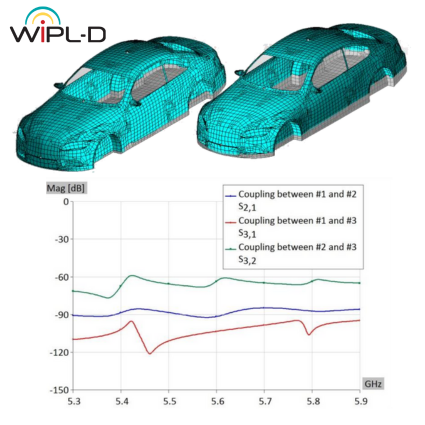
Automotive EM simulations are essential for designing vehicle systems. One of the most demanding problems is vehicle-to-vehicle communication and interaction with the environment. Main applications include toll and safety systems, autopilot and parking sensor systems, with an emerging frequency band at 5.9 GHz. This note shows three monopole antennas placed on a generic car model, simulated by MoM on a desktop with two 12-core CPUs and four low-end GPUs. In the advanced scenario, two cars with six antennas are analyzed. Without symmetry, the total number of unknowns is 364,262. Simulation time with MoM is hours, while DDS solver completes it in under 30 minutes. Results include antenna radiation patterns, return loss, and coupling.

View PDF

RF Antenna Placement on A320

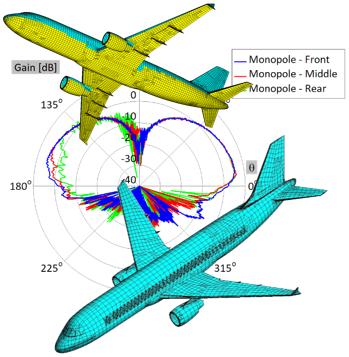
This note presents WIPL-D simulations of two electrically large scenarios. The first involves a monopole antenna on an Airbus A320 model (simulated at 833 MHz), and the second includes three monopole antennas at different positions on the aircraft (simulated at 1.53 GHz). Results demonstrate WIPL-D capabilities in antenna placement. Converting CAD files to WIPL-D Pro format is done through WIPL-D Pro CAD. Antenna placement reduction or Unused Entities reduce computational resources without compromising accuracy. Efficient CPU simulation is complemented by GPU Solver. These EM simulations allow engineers to experiment with antenna models, environments, clearly showing wings, tail influence patterns.

View PDF

Indoor Wi-Fi Antenna at 2.4 GHz

In this application note, near-field results of an indoor Wi-Fi antenna at 2.4 GHz are presented. The antenna is carefully placed inside a room with brick walls, and free-space results are also shown for direct comparison. The near-field distribution inside the room is plotted on 501×501 points. All simulations are performed using WIPL-D software suite. The first simulation is without reduction, and the second uses smart reduction with two symmetry planes. Simulations run on a regular PC with GPU for MoM matrix inversion. Smart reduction halves unknowns, reduces memory ~4 times, and decreases simulation time ~9 times without affecting results. All outcomes match theory, and indoor results clearly show wall reflections compared to free-space results.

View PDF

Helicopter Rotor Effects on Antenna Radiation Patterns

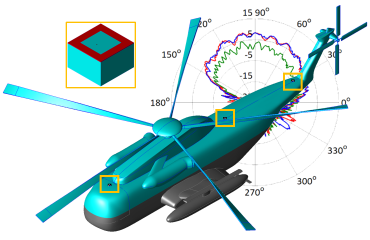
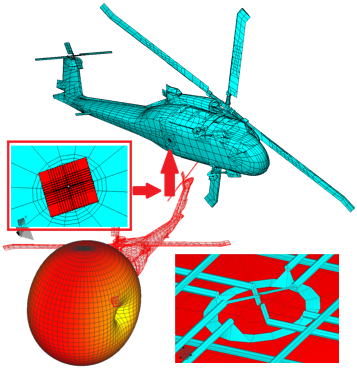
This application note examines and analyzes the influence of main rotor movement on the radiation patterns of three microstrip patch antennas mounted on the upper surface of a helicopter, operating at 2.625 GHz. Three different rotor angles (0°, 12°, and 24°) were carefully investigated and compared. The smart reduction feature effectively reduces unknowns, significantly saving computational resources, while GPU Solver greatly accelerates matrix inversion and decreases total simulation time. Rotor rotation mainly affects the front antenna, whereas the rear antenna is only minimally influenced. All simulations were carried out using WIPL-D full-wave 3D EM Method-of-Moments software applying Surface Integral Equations for accurate results.

View PDF

Laptop with Inverted F Antenna

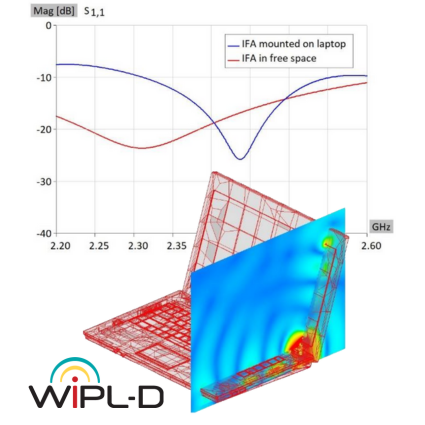
EM simulations of laptops and mobile devices have grown popular due to expanding capabilities of modern software and hardware. Antennas are introduced in final design phases, so modeling often begins by importing device geometry from third-party software into an EM editor. Imported models contain many irrelevant details and irregularities. This application note shows how WIPL-D Pro CAD is used for EM simulation of an inverted F antenna at 2.4 GHz mounted on a laptop, including preparation of the imported model. Despite complex geometry, WIPL-D’s quad meshing produces a 3,500-element model. Simulations on a desktop PC with an inexpensive GPU take minutes, demonstrating high efficiency for modeling and EM analysis of complex RF geometries.

View PDF

ADF Antenna Mounted on Helicopter

WIPL-D Pro is a full-wave 3D EM solver based on MoM with quadrilateral mesh and higher-order basis functions (HOBFs). This unique combination enables highly accurate and reliable simulation of electrically large models with very efficient CPU and GPU performance on inexpensive hardware platforms. The magnetic antenna system, patented by
G. Wennerberg, is used as a direction-finding antenna. Although MoM is often challenged for electrically small devices, WIPL-D Pro simulates them efficiently and very accurately. Radiation patterns are obtained in free space and mounted on a realistic helicopter model at 190 kHz and 535 kHz. Low-frequency simulations, not usually a MoM application, run on a standard desktop or laptop in just a few minutes.

View PDF

Real Ground Option Used in Boat-at-Sea Scenario

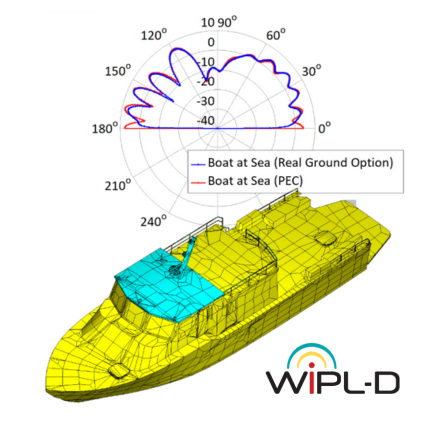
The application note describes simulation of a real-life antenna placement environment, clearly considering monopole mounted on a boat in sea water. In the first project, sea water influence on the radiation pattern was modeled using the Real Ground option with sea water dielectric properties. In the second, sea water was approximated as an infinite PEC plane. In the third, Unused Entities with PEC approximation were applied. Results matched expectations: conductive sea water does not significantly affect antenna return loss, and Unused Entities produce negligible differences in current distribution. PEC approximation affects radiation patterns near θ = 0° and 180°. All simulations were performed on a standard, cost-effective workstation.

View PDF

Combat Vehicle with GPS Antenna above Real Ground

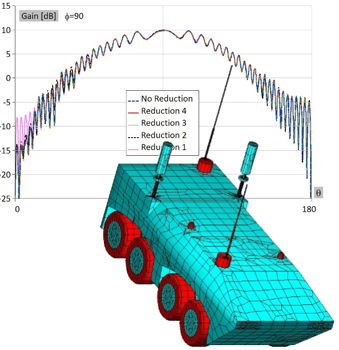
This application note presents the simulation of a GPS antenna radiation pattern mounted on a combat vehicle over infinite real ground. The note illustrates reduction of unknowns using WIPL-D Pro’s Unused Entities feature, demonstrating efficiency of the approach. The reduction is possible because only objects near the antenna affect the radiation pattern, making it unnecessary to simulate the entire surrounding structure in detail for accurate results. The antenna, covered with a protective radome, is located on the vehicle roof, with infinite real ground below. All models are simulated at 1500 MHz on a powerful desktop with 2 12-core CPUs, ample RAM, and 4 low-end Nvidia GTX 1080 Ti GPUs. All simulation times are completed in minutes.

View PDF

Automotive Applications

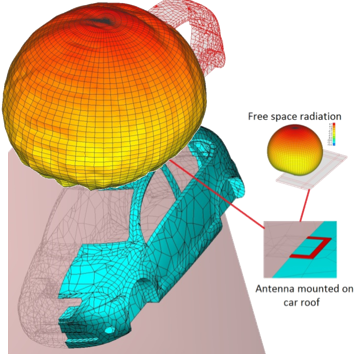
EM simulations are crucial in the automotive industry. WIPL-D software supports this field with CAD tools (for easy import, modeling, and positioning of devices in complex geometries) and GPU Solver (extending frequency range). Domain Decomposition Solver (DDS) handles electrically large problems. This note presents three cases: GPS, Bluetooth-GSM, and FM, simulated on a desktop with 2 CPUs (12 cores each) and 4 GTX 1080 Ti GPUs, all in minutes. GPS Antenna Mounted to Car Roof demonstrates a patch antenna on a Citroen shell. Bluetooth and GSM Interference simulates devices inside the car, including GSM and Bluetooth on the dashboard. FM Antenna Immersed into Glass Window shows a 108 MHz FM wire antenna in the window with heating wires.

View PDF