
Wideband Monopole Antenna with Rotational Symmetry

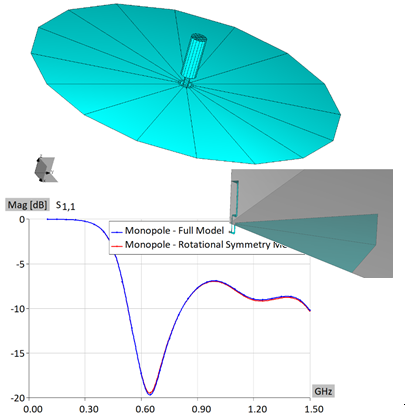
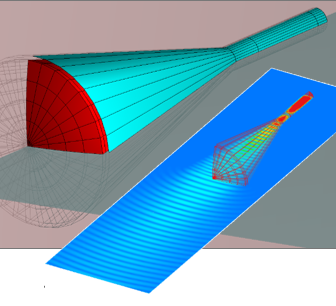
Two models of the wideband monopole antenna were efficiently simulated using WIPL-D Pro Software. S-parameters and radiation patterns at 0.6 GHz were accurately calculated and compared. Key details regarding monopole modeling and the powerful Rotational Symmetry feature are highlighted. The first simulation was performed without simplifications, while the second leveraged Rotational Symmetry to model only the n-th part of the structure. Results clearly confirm that using this option delivers precise outcomes in much shorter time. All modeling and simulations were executed using WIPL-D full-wave 3D electromagnetic Method-of-Moments software with Surface Integral Equations. Simulations remain extremely efficient even on a standard laptop.

View PDF

Yagi-Uda Antenna

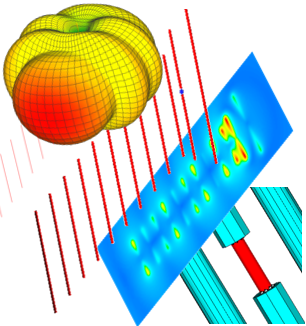
The Yagi-Uda antenna is a dipole antenna whose radiation is focused by a series of parallel dipoles and a reflector behind. It is mostly used in radio links for computer networks, TV, and FM reception. Two Yagi antenna models are simulated in WIPL-D. In the first, the radiating element, ten directors, and reflector are modeled as wires, while in the second they are made of plates (solid body). Symmetry is discussed in detail. Simulations are done extremely quickly (in seconds) on a regular desktop PC with a low number of unknowns. The note shows advantages of wire models, easier to develop and simulate, enabling the solution of very complex problems with thousands of wire elements without using more precise and demanding plate models.

View PDF

UHF Panel Antenna

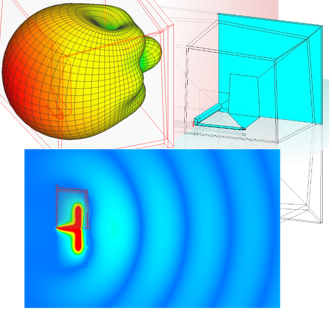
Ultra-High Frequency Panel antennas (UHFP) consist of radiating surfaces and a reflector, and have been widely used in TV and modern communication systems worldwide. In this application note, the antenna is fully covered with a protective radome and fed by coaxial cable. To speed up simulations and simplify modeling, two symmetry planes are applied. The antenna is simulated in the 0.47–0.86 GHz band. Built-in interpolation allows simulation with minimal frequency points. WIPL-D efficiently analyzes this antenna in a fraction of a second on a standard desktop or laptop, using the Method of Moments with unique higher-order basis functions, generalized quadrilateral mesh requiring fewer unknowns, and no bounding box for open region problems.

View PDF