
Corrugated Horn in WIPL-D Pro Software

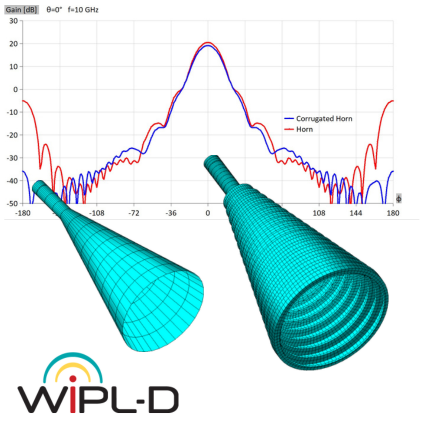
In this note, we compared simulated radiation patterns for a circular horn antenna and corresponding corrugated horn antenna using
WIPL-D Pro’s built-in object Body of Connected Generatrices. All simulations were carried out with WIPL-D, a full-wave 3D EM MoM solver based on Surface Integral Equations. The corrugated horn antenna can be efficiently created by combining the Body of Connected Generatrices object with WIPL-D symbolic mechanisms. Results show back-lobe levels are significantly reduced. Simulations were performed with high numerical efficiency, resulting in short simulation times even on a standard desktop workstation, demonstrating WIPL-D’s robust capabilities for complex antenna designs.

View PDF

Frequency Effects on Dielectric Constant and Loss Tangent

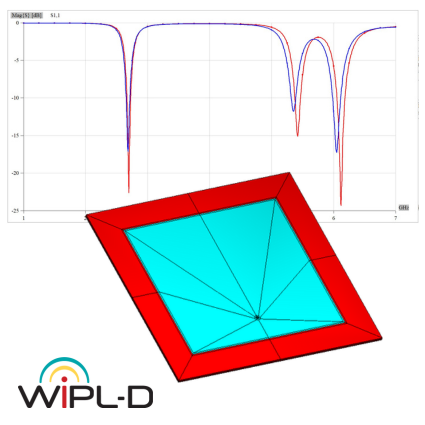
This document demonstrates how to introduce frequency-dependent dielectric parameters in WIPL-D Pro, a full-wave 3D EM simulator. Most materials used in microwave circuits and antennas vary with frequency, which must be carefully considered in EM simulations to predict device performance accurately. This is crucial when simulations are expected to provide high-fidelity results for validation against measurements. A simple patch antenna from 1 GHz to 7 GHz is modeled and simulated, with results in about one minute on a standard workstation, confirming WIPL-D’s efficiency. Frequency dependency can apply to any symbolically defined parameter, such as length or radius, with multiple parameters handled via tabulated data in the project file.

View PDF

Compact Dual-Band Fork Monopole

This paper illustrates the advantages of WIPL-D Pro by simulating a simple printed fork-shaped dual-band antenna for Bluetooth and general UWB applications. For printed patch antennas and circuits, using WIPL-D features such as Symmetry planes and Manipulation Edging yields fast, accurate solutions. Efficient simulation on multicore CPUs allows execution in seconds on inexpensive desktop and laptop PCs, eliminating the need for high-end hardware even for electrically small or moderate structures in wide frequency bands. The application note also highlights the importance of the feeding area in printed models, where transitions between several guided-wave technologies, such as coaxial to microstrip in this case, are critical for accurate simulation.

View PDF

Vivaldi Antenna

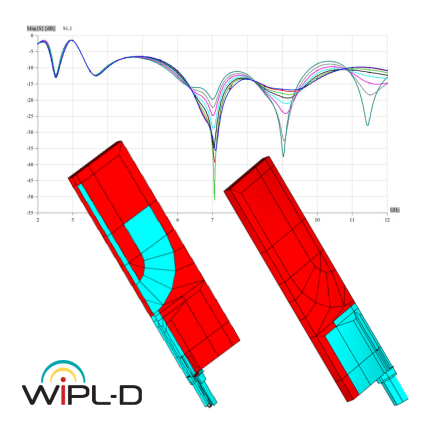
Vivaldi antenna is a commonly used antenna in broadband applications, usually printed on a dielectric substrate. The simulation results show an extremely wide band (return loss under -10 dB). The simulation is performed with a low number of frequency points due to the powerful built-in interpolation method, which overcomes the typical MoM drawback of simulating each frequency point separately. In MoM, simulation is fast at the lowest operating frequency but more demanding at the higher end. WIPL-D simulates each frequency point according to the current frequency, decreasing overall simulation time several times. Here, the simulation is performed using a regular desktop quad-core CPU and lasts only a couple of seconds per frequency point.

View PDF

Hyperboloid Lens Antenna Design Guide

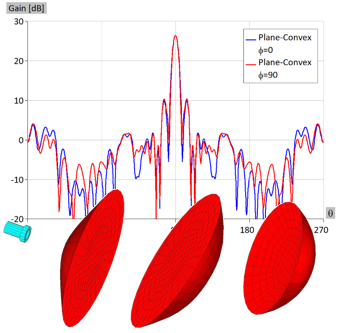
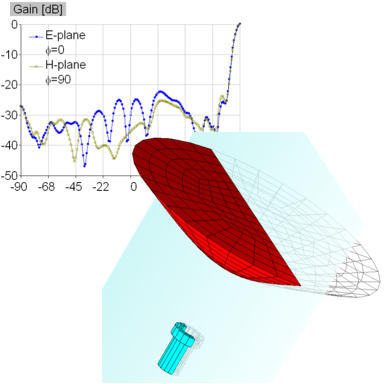
The model of a hyperboloidal lens illuminated by a choke horn antenna was successfully designed and simulated using WIPL-D Pro software. The modeling process includes usage of WIPL-D Pro built-in objects, ensuring an optimal number of unknowns, which simplifies the modeling process and significantly speeds up the simulations. The radiation pattern of the free-space choke horn was compared to that of the lens antenna, clearly demonstrating the focusing effect. This effect is further illustrated by calculating the near field both in front of and behind the lens. All simulations were carried out in just a few seconds on an inexpensive desktop PC, showing the efficiency, speed, and accuracy of the software for practical lens antenna design.

View PDF

Microstrip Patch Antenna [Verification by Measurement]

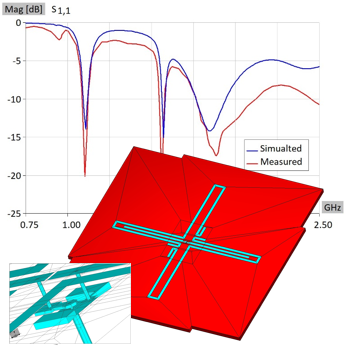
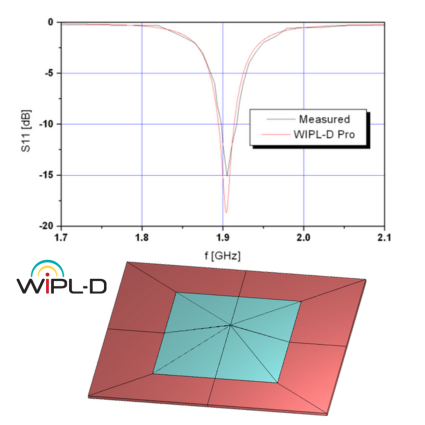
Microstrip patch antennas are among the most popular types, used in various applications. Modeling is typically straightforward and can be done in WIPL-D 3D modeler, WIPL-D Pro. More complex geometries or CAD designs can be prepared in WIPL-D Pro CAD or AW Modeler. A simple microstrip patch antenna is simulated. The simulation itself is not primary, as printed antennas run in seconds on a desktop or laptop. The application note focuses on verifying simulation results with measurements by the WIPL-D team. The software predicted resonance at 1.905 GHz, while measurements indicated 1.906 GHz. The simulated bandwidth is 19.35 MHz, with measured 19.3 MHz, giving a relative discrepancy of 0.05 % for resonant frequency and 0.25 % for bandwidth.

View PDF

Printed Monopole Antenna for 5G Network Frequency Bands

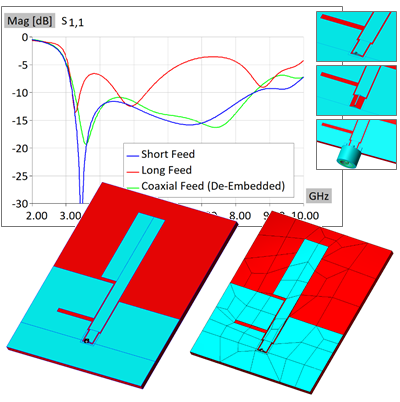
This note presents the analysis of an antenna operating in 5G network frequency bands using WIPL-D Software. S-parameters and radiation patterns of a printed monopole antenna fed with a coplanar waveguide were calculated and carefully compared. All simulations and modeling were performed using WIPL-D, a full-wave 3D electromagnetic Method-of-Moments solver based on Surface Integral Equations. Simulations are fast, accurate, and agree well with referenced results. The note clearly demonstrates how a planar structure can be built with minimal effort in WIPL-D Pro CAD, including realistic antenna connections modeled with three different feeders, achieving high numerical efficiency and very short simulation times even on a laptop.

View PDF

Helix Antennas

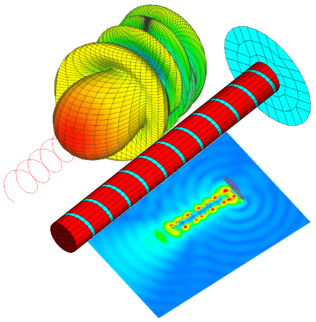
Discovered by scientist Krauss in 1946, helix antenna is used in space applications, radar systems, and more. It is usually manufactured as a wire coiled around a dielectric cylinder, producing circular polarization of the emitted EM wave. This application note compares simulation times, number of unknowns, and radiation patterns for three simulated helix antennas: wire helix, thin strip helix, and thin strip with dielectric mast. In WIPL-D software, various helix antennas can be efficiently designed using the powerful built-in Helix object. Simulations were carried out on a regular desktop PC with extremely low number of unknowns and times measured in seconds, allowing fast tuning, sweep, or optimization of the antenna for engineering.

View PDF

Spiral Antennas

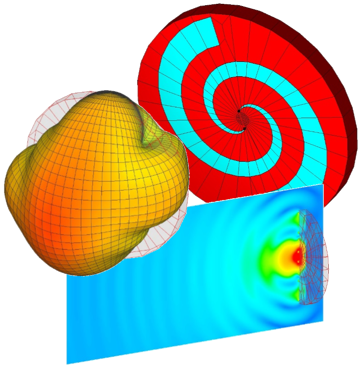
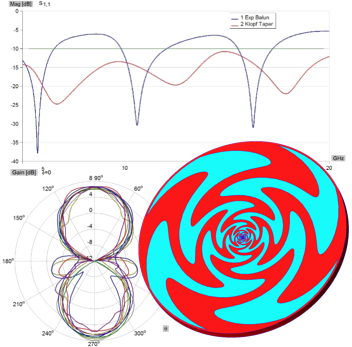
In this application note, we analyze two spiral antennas, one with an air substrate and the other with a dielectric substrate between spiral arms and metallic reflector. In WIPL-D Pro, a spiral can be easily created and modified using the built-in Helix object. Especially when the same mesh over close surfaces is required (antenna reflector and spiral arms), the built-in Copy\Layer manipulation is very useful and simplifies model setup significantly. The antennas are simulated from 0.3 GHz to 6 GHz in a wide frequency band. Number of frequencies is reduced using logarithmic scale and built-in interpolation. Simulation was carried out on a regular desktop PC with extremely low number of unknowns, and simulation times measured in seconds.
View PDF

Rectangular Horn Antenna

A magnetic antenna system patented by G. Wennerberg can be efficiently used as a direction-finding antenna (DFA). It is suitable for mounting on aircraft as it has no moving parts. This application note presents simulation results for an electrically small DFA with two coils wrapped around magnetic material in orthogonal directions. The smallest mesh element is about 0.2 mm, ~1/8,000,000 wavelength. The DFA was simulated using WIPL-D Pro, 3D EM solver based on method-of-moments. Results show MoM can simulate extremely small, low-frequency structures accurately. Coupling between ports remains precise down to -60 dB, and simulations run efficiently on a desktop or laptop, demonstrating the robustness and versatility of this antenna design.

View PDF

Dielectrically Loaded Circular Horn Antenna

In this application note, two models of circular horn antenna were simulated using WIPL-D software, with special attention to the dielectrically loaded horn antenna. The influence of dielectric loading is most noticeable in the back lobe of radiation, which is significantly suppressed when a dielectric load is applied. To reduce the number of unknowns and simulation time, two symmetry planes were used in each model. Both models were simulated fast with minimal computational requirements, and the simulation lasted seconds. These results demonstrate efficiency and accuracy of WIPL-D for modeling such antennas and its suitability for parametric studies, design optimization, and evaluation of different configurations and dielectric materials under realistic conditions.

View PDF

Ultra-Wide Band Elliptical Antenna

The application note presents the simulation of a UWB elliptical antenna, covering 5–14 GHz. The antenna is electrically small and requires few unknowns. Simulation results demonstrate accurate performance across the frequency band, with VSWR, radiation patterns, and key parameters. Several features improve simulation time: usage Method of Moments with higher order basis functions, symmetry halving unknowns, and reduced frequency points via built-in interpolation, ensuring fast, accurate results for complex designs. Although WIPL-D is a frequency-domain solver, it handles UWB antennas efficiently. With execution on multicore CPUs, simulations run on an inexpensive desktop quad-core PC and last only a couple of seconds per frequency point.

View PDF