
Validating IFA Design via Measurement

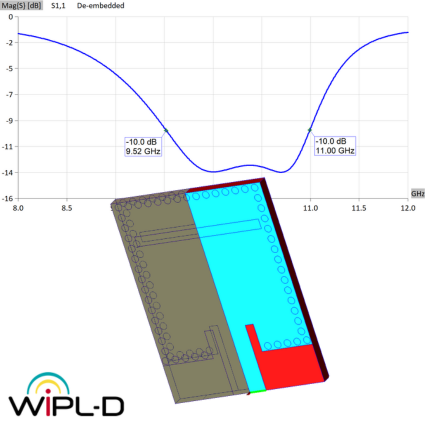
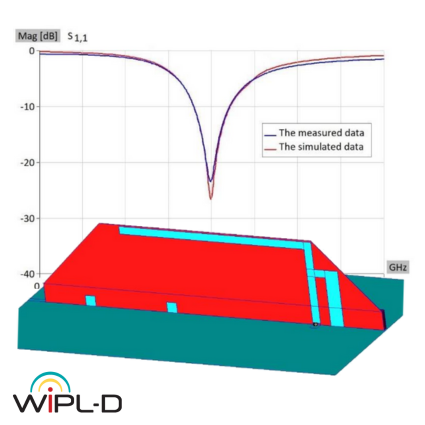
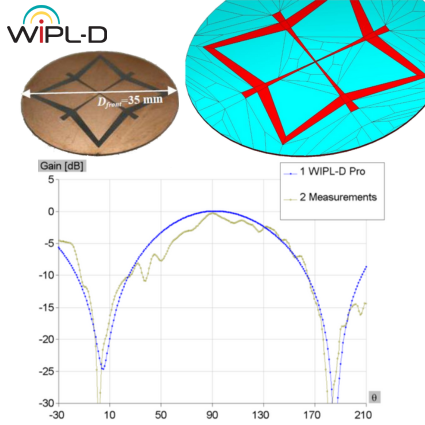
This application note presents the design of a printed inverted-F antenna (IFA) used in an RFID reader in mass production. The IFA was carefully built and simulated using WIPL-D Pro CAD, a method-of-moments (MoM) based EM simulation tool. Real-life effects, such as influence of neighboring metallic objects, were fully included and considered during simulation. Simulation was carried out on a regular desktop PC in about one minute per frequency point, efficient given the thin flexible substrate (100 µm) and complex real-life environment. Test samples were fabricated and measured, showing excellent agreement. Beyond developing EM tools, WIPL-D also provides consulting, leveraging years of support, education, university collaboration, surveys, and projects.

View PDF

Luneburg Lens Illuminated by Corrugated Horn

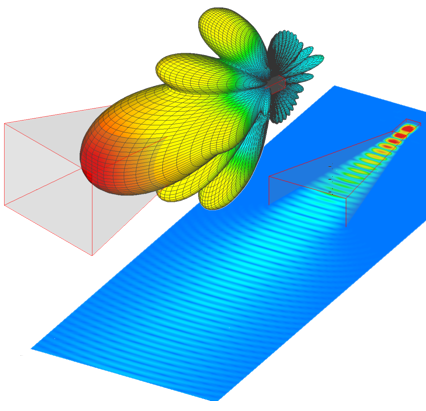
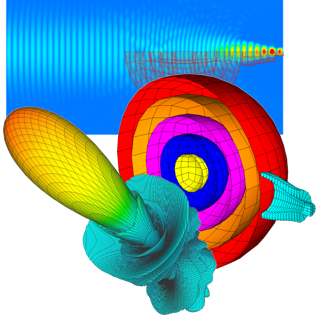
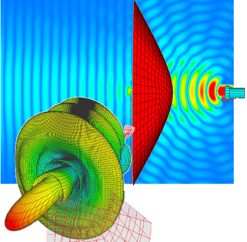
The lenses are antennas designed to collimate incident energy and to prevent it from spreading in undesired directions (the beam focusing). In this application note, we also show Luneburg lens illuminated by corrugated horn antenna. The lens is represented as spherically symmetric structure with variable index of refraction. Basically, Luneburg lens is modelled in WIPL-D Pro as 5 spheres with coinciding centers. The simulation results include 2D and 3D radiation pattern, as well as focused near field. Comparing free space radiation with the radiation of the overall lens shows energy collimation and gain increase. Simulations are carried out at inexpensive desktop PC, while the simulation can be further speeded up by using the GPU solver.

View PDF

Compact Multi-band Antenna for Wireless Applications

The aim of this application note is to demonstrate the capabilities of
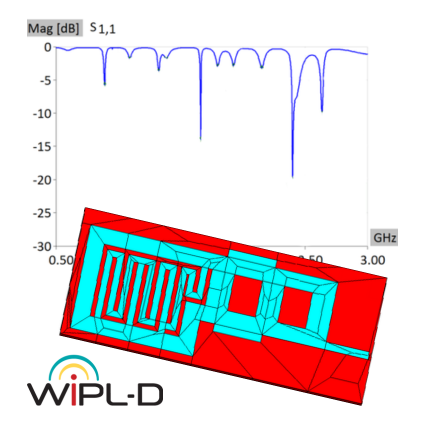
WIPL-D Pro 3D EM Solver for design and simulation of complex printed antennas in a wide band. WIPL-D Pro CAD is used, allowing Boolean operations, solid modeling, automated quadrilateral meshing, and other features such as total imaging and edging, all completed in seconds. The model follows specifications from Microwave Journal, May 2008. The full process of parametric model creation and simulation in WIPL-D Pro takes about one hour. Simulations run in seconds per frequency point on a desktop PC with very few unknowns. The 0.5–3 GHz frequency band with 10 resonances requires only 65 points thanks to the powerful built-in interpolation, providing highly accurate results.

View PDF

Crossed Exponentially Tapered Slots Antenna (XETS)

Application note shows the complete simulation process for an antenna designed externally from the WIPL-D suite and provided as CAD geometry (STEP) file. It includes import, healing, material assignment, meshing, and simulation. Importing the file in a single click creates a project with several metallic parts. WIPL-D Pro CAD offers advanced automated healing tools. After a single Boolean unite, the CAD model becomes a single body ready for meshing. The default algorithm with specified local mesh size precisely follows geometry at three very close coaxial surfaces. Simulations last only a couple of seconds per frequency point on any PC or laptop. VSWR (3.1-10.6 GHz) and pattern (4 GHz) results show excellent agreement with measured data.

View PDF

Log-Periodic Dipole Antenna in WIPL-D Pro CAD

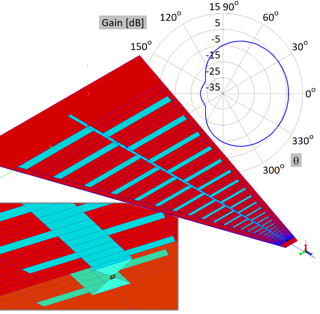
This application note presents a model of a Log-Periodic Dipole Antenna (LPDA) designed in WIPL-D Pro CAD software. The LPDA has 52 printed dipoles created from scratch. The antenna boom is 261.5 mm long, with the longest arm about 84 mm and the shortest about 2 mm. Wide-band simulation is significantly faster when the model is re-meshed at each frequency and the number of unknowns is automatically adjusted using a special WIPL-D feature. Built-in interpolation allows simulating return loss with a minimal number of frequency points, maintaining high accuracy. The simulation was performed on a desktop PC equipped with a low-end Nvidia GPU, with matrix inversion efficiently accelerated by the WIPL-D GPU solver, giving fast reliable results.

View PDF

Sierpinski Multiband Monopole Antenna

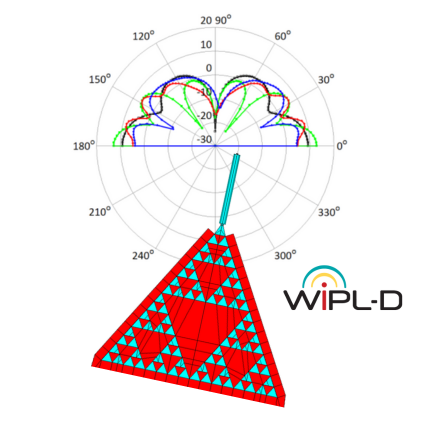
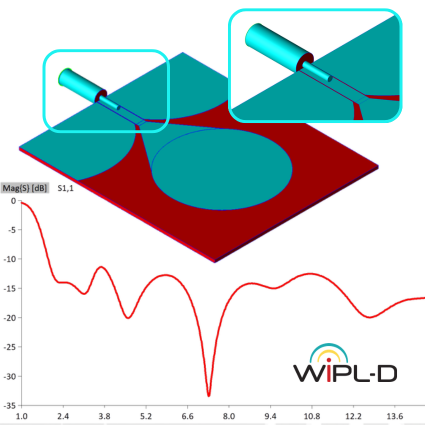
Design of Sierpinski antennas is based on the Sierpinski triangle – a well-known planar fractal. These antennas are commonly used where operation at multiple frequencies is required and can be easily fabricated with conventional printed circuit technology, found in cell phones and various Wi-Fi devices. In WIPL-D simulations, symmetry is applied. The antenna is placed above an infinite PEC plane and fed using a 50 Ohms coaxial feeder below the PEC (apertures in PEC/PMC plane). The simulation was performed on a regular desktop PC in just a couple of seconds per frequency point. The frequency range is 0.1–16 GHz over 60 frequency points using built-in interpolation. Comparison of measured and simulated return loss confirms excellent accuracy.

View PDF

Hyperboloid Lens Illuminated by Choke Horn Antenna

This paper presents the procedure for the design of a hyperboloid lens antenna, including theoretical considerations, foundational principles, and steps for implementation in the WIPL-D software suite. The hyperboloid lens antenna consists of two main parts: a feeding cylindrical waveguide and the dielectric lens, so the design procedure is divided into two stages corresponding to each part. Finally, the application note demonstrates the WIPL-D Pro model at 25.5 GHz, showing its radiation pattern, important simulation details, and results. The simulation is carried out in seconds on a standard inexpensive PC, illustrating the efficiency of the software and its suitability for rapid parametric studies and practical antenna development.

View PDF

Dual-Band GPS Antenna

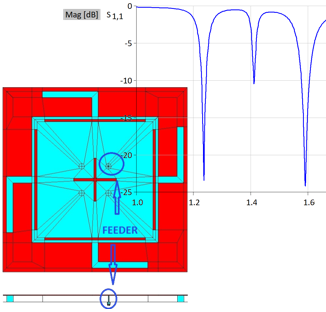
The design of a dual-band antenna is an essential part of any GPS system. Most modern GPS receivers operate in the L1 band (1575 MHz) with right-hand circular polarization, while many applications require more accurate positioning information and use both L1 and L2 (1227 MHz) bands. This application note presents WIPL-D Pro simulation of a dual-band antenna intended for GPS. The antenna is a slot-loaded microstrip patch with coaxial feed. The results show
S-parameters lower than −20 dB in both L1 and L2 bands, demonstrating very excellent matching and performance across bands. Simulations are performed with a low number of frequency points using built-in interpolation, on a regular desktop PC, eliminating the need for expensive high-end workstations.

View PDF

Sinuous Antenna

The design of a sinuous antenna is often required in wideband airborne and communication applications. At low frequencies, the outer rings resonate, while at high frequencies the inner rings are resonant. At microwave frequencies, coaxial cable (unbalanced waveguide) is the most commonly used feeder. A balun transforms the input signal from unbalanced to balanced. A printed balun (microstrip technology) is placed below the planar sinuous antenna. Two baluns, Exponential and Klopfenstein taper, are analyzed, yielding return loss under -10 dB across an extremely wide band. EM simulations were carried out on a regular desktop computer at only 16 frequency points, thanks to built-in interpolation, with simulation times measured in seconds.

View PDF

Cross Spiral Antenna (CSA)

This application note presents the design and simulation of a Cross Spiral Antenna (CSA), a compact planar antenna, based on the paper “A multi-polarization multi-band cross spiral antenna for mobile communication devices”, ISAP 2012. The CSA exhibits good performance at three frequency bands, intended for combined RFID, mobile-phone (UMTS), and GPS applications at 1.0 GHz, 1.8 GHz, and 1.67 GHz, respectively. The printed device is fabricated on low-cost FR4 substrate (Er = 4.4, Hsub = 1.6 mm). The feeding area was realized in two ways: a simple wire bridge and a coaxial feed with connector. Both approaches yielded stable, similar results. Simulations were performed on a standard desktop PC, with times measured in seconds, showing great agreement with measured data.

View PDF

Various Lens Types

Three designs of lens antennas with different lens types are presented, suitable for real-life radar, satellite, and advanced communication applications. The first scenario assumes the lens surface closer to the horn is hyperbolic and the far surface is flat; the other two scenarios are plane-convex and concave-convex. Calculations are efficient due to the Method of Moments (MoM) with higher-order basis functions, allowing mesh elements up to 2 wavelengths. WIPL-D’s built-in reflector object minimizes simulation requirements for large apertures. Accuracy is controlled via segment adjustment, and all simulations converge quickly within a few runs on a standard desktop or laptop, lasting only a couple of seconds, showing robust performance.

View PDF

Discone Antenna

In this application note, four models of the discone antenna are simulated to demonstrate real-life operation. Dielectric support, radome covering, material losses, and frequency-dependent dielectric characteristics are all included for completeness and accuracy. All models are created using WIPL-D Pro CAD, which supports Boolean operations, necessary for modeling the complex mast, pedestal, and radome intersecting each other. The discone antenna is a wideband structure, simulated quickly and accurately using WIPL-D, a Method of Moments (MoM) code based on Surface Integral Equations (SIE). Efficient execution on multicore CPUs, use of symmetry, and built-in interpolation allow simulation of the UWB antenna on a regular desktop PC
(0.5–10.5 GHz, 55 frequency points).

View PDF