
Microwave Imaging Systems for Medical Applications​

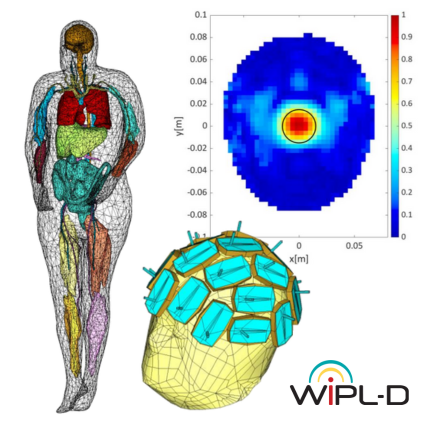
A fully functional module for microwave imaging is implemented in WIPL-D Pro 3D EM simulation environment. Software enables creation of anthropomorphic phantoms from STL files, converting triangular meshes to quadrilateral meshes to improve accuracy and reduce computational load. A semi-automatic antenna placement positions antennas optimally around the head while avoiding intersections. The imaging scenario is simulated at 1 GHz, and differential S-parameters are analyzed directly and via the TSVD algorithm. Simulations with and without stroke allow detection, localization, and size estimation, showing that WIPL-D provides an efficient and accurate solution for EM-based microwave brain imaging research and medical diagnostics.
View PDF

PC Case as EMC Cavity

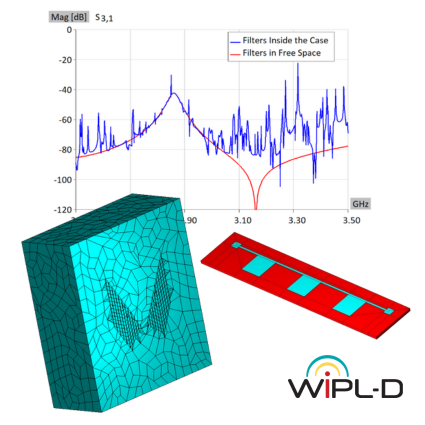
WIPL-D software suite packs wide range of powerful EMC simulation tools, clearly demonstrated through EM analysis of a metallic PC-tower case. The realistic 45×40×18 cm model is quickly built in WIPL-D Pro CAD using solid modeling and quadrilateral mesher that produces large quads on flat surfaces and fine quads around tricky details, capturing geometry cleanly. One scenario evaluates the input impedance of a wire dipole inside the case, revealing cavity-mode resonances, while a more demanding test places two microstrip filters inside and examines their S-parameters. Even these complex setups run on a standard desktop in under a minute per frequency point, with the option to speed things up further using an inexpensive GPU for efficiency.

View PDF

EMI Shielding of RG-58

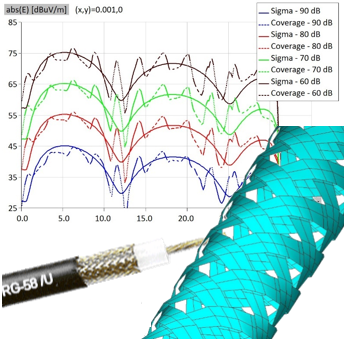
This application note demonstrates that WIPL-D can efficiently simulate EMI propagation inside cables and lines, focusing on an advanced RG-58 coax cable model with imperfect braid shield, which can easily be replaced with a very simple equivalent model. After this transformation, run times are measured in seconds, enabling fast and highly accurate analysis of even the most complex scenarios. Using a 2 m coax cable, it is shown that minimal field suppression reduces internal field by two orders of magnitude compared to an open end, while induced field in a microstrip line is an additional order larger. All simulations are carried out on standard desktop computer, with significant speed-up on multicore CPUs or even a single inexpensive GPU card.

View PDF

EM Shielding of Conductive Spherical Shell

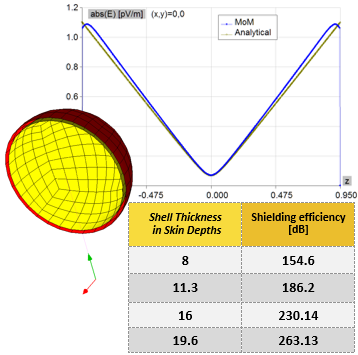
Electromagnetic shielding reduces EM fields by blocking them with conductive or magnetic materials to prevent unwanted coupling between device’s interior and exterior. This application note focuses on shielding achieved by enclosing the protected area in a conducting spherical shell, where the analytical Mie-series solution applies. To significantly reduce interference inside the shell, its walls must be several skin depths thick, creating a large field contrast between the outer and inner surfaces and requiring rigorous EM simulation. Results show that WIPL-D provides highly accurate shielding analysis, matching analytical predictions even above 260 dB efficiency, while running on a standard desktop with few unknowns in just seconds with reliability.

View PDF

MIMO OTA in Anechoic Chamber

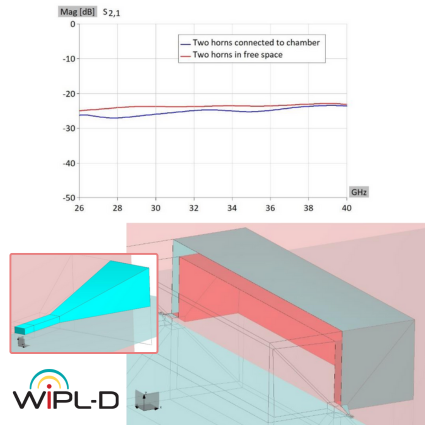
This note demonstrates simulation of MIMO systems using WIPL-D, focusing on over-the-air (OTA) analysis inside a large, material-coated anechoic chamber. Antenna placement and material characterization, often unknown, are emulated to satisfy simulation requirements. Simulations are performed on multicore CPU and multi-GPU workstations, achieving short runtimes over wide frequency bands, with smooth results via built-in interpolation using only 15 points. Single-point simulations can run on a standard desktop with a GPU. WIPL-D’s efficient EM kernel, GPU solver, and material modeling enable full-wave simulation of large chambers (80λ) that would otherwise seem impossible, providing accurate and fast performance predictions.

View PDF

Resonant Frequencies in Rectangular Waveguide Cavity

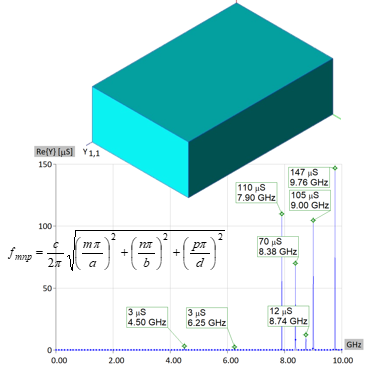
This note shows the determination of resonant frequencies in microwave cavities, where complex shapes and interior structures often prevent analytical calculations. WIPL-D Pro CAD provides an accurate, easy-to-use tool for high-precision EM simulations, with results verified against established theory. Simulations run rapidly on a standard desktop, and the built-in interpolation allows obtaining precise frequency-domain results with low number of frequency points. Exciting the cavity with a dipole and generator proves highly effective, enabling all resonant frequencies to be identified and closely matching analytical values, demonstrating the reliability, efficiency, and accuracy of WIPL-D for cavity analysis and design applications.

View PDF

Emulating Electrical Properties of Magnetic Ferrite Tiles

This application note demonstrates emulation of magnetic ferrite tile properties in WIPL-D Pro with WIPL-D Optimizer. Often electrical properties are unknown, while datasheets provide performance characteristics. Such materials are used as absorbers in EMC problems, making accurate modeling essential. The coaxial tube method is employed: a hollow tube of the material is inserted into a coaxial line, and EM expressions optimize properties to match datasheet performance. TDK IB-017 ferrite tiles are analyzed. Linear and parabolic models yield excellent agreement with datasheet data. Simulations are fast, efficient, and require no special hardware, demonstrating WIPL-D’s capability for precise material emulation and practical EMC design and validation.

View PDF

Windmills WIPL-D EM Simulations

WIPL-D MoM excels at RCS simulations of electrically large structures, using higher-order quad meshes, optimized CAD geometry, highly efficient CPU/GPU computation and effectively reducing unknowns in EM-insignificant regions. This application demonstrates wind turbine simulation, including tall masts, resistive coatings, and near-field shadow zones. A hybrid approach combines WIPL-D 2D solver for infinite cylinders, DDS high-frequency iterative solver validated against full-wave MoM, and full-turbine simulation at 3 GHz frequency. While conventional MoM would take days for millions of unknowns, WIPL-D achieves accurate results in hours to a couple of days,  leveraging multicore CPUs, available RAM, and inexpensive GPUs.

View PDF

Box with Slot Shielding Effectiveness

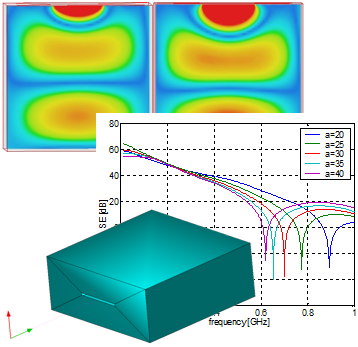
The aim of this application note is to calculate the shielding effectiveness of PEC box with a slot excited by a plane wave incident perpendicular to the slot. Shielding effectiveness is defined as the ratio of the impinging field to the field measured at a chosen point inside the waveguide, distant from the slot. Theory assumes single TE10 mode propagating from the aperture, but higher-order and off-axis modes may appear, requiring EM simulation for accurate prediction. WIPL-D results show excellent agreement with intermediate-level tools from the University of York, including their online calculator. The objective is to examine how changes in box or slot geometry, as well as field-probe position, affect shielding performance by varying one parameter at a time.

View PDF

SAR-Human Head Exposed to Mobile Phone

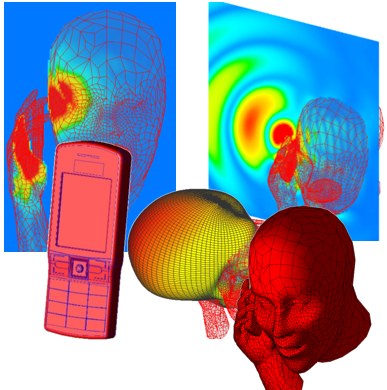
With widespread use of modern communication devices, evaluating the effects of electromagnetic (EM) fields on the human body is essential. This application focuses on a mobile phone’s impact on a human head at 1.8 GHz. Using WIPL-D’s efficient MoM solver, realistic CAD models of the phone and head were imported, repaired, and fully meshed in WIPL-D Pro CAD. The phone radiates via PIFA, exposing the head phantom to EM fields, analyzed through near-field and SAR calculations. Radiation patterns for three scenarios (PIFA in free space, mounted to the phone, and near the head) are presented. Simulations run on a standard quad-core desktop, with GPU acceleration using inexpensive Nvidia GTX cards, reducing model times to seconds or minutes.

View PDF

Basic EMC Examples

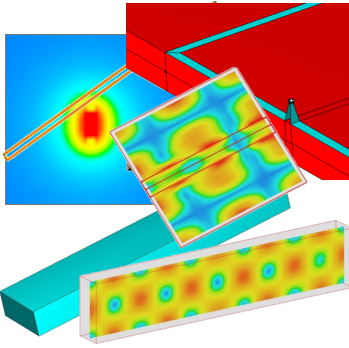
Electromagnetic environment is an integral part of the modern world, created intentionally or not by various sources. Strong EM fields can affect the operation of electrical and electronic devices. The ability of a device to operate without causing intolerable EM disturbances is called electromagnetic compatibility (EMC). WIPL-D Software emulates numerous EM experiments, offering efficient Method-of-Moments (MoM) simulation, GPU/CPU computation on low-cost platforms, handling large-to-small details, and dedicated support, making it a capable EM simulator. EMC capabilities are demonstrated with examples including EM fields near transmission lines, waveguide resonators, wires in cavities, microstrip lines with slots, and printed circuits.

View PDF